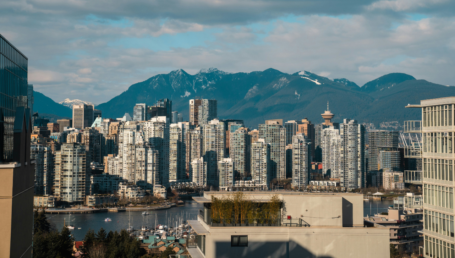

Whether it’s the quiet suburban vibe of Kerrisdale or the community-minded spirit of Cedar Cottage, Vancouver has its distinctive neighbourhoods.
That distinction could be lost, say planning experts. They worry that the City of Vancouver’s newest plan to drop large pockets of six-storey density into existing neighbourhoods—which they call villages—could erode character and homogenize streetscapes with boxy mixed-use buildings already seen on every major arterial route. You know the look: four- to six-storey concrete low-rises with glass awnings over glass-fronted retail spaces that line a blank, featureless sidewalk. With higher rents, they tend to attract chains instead of mom-and-pop retailers, and they often take a long time to fill.
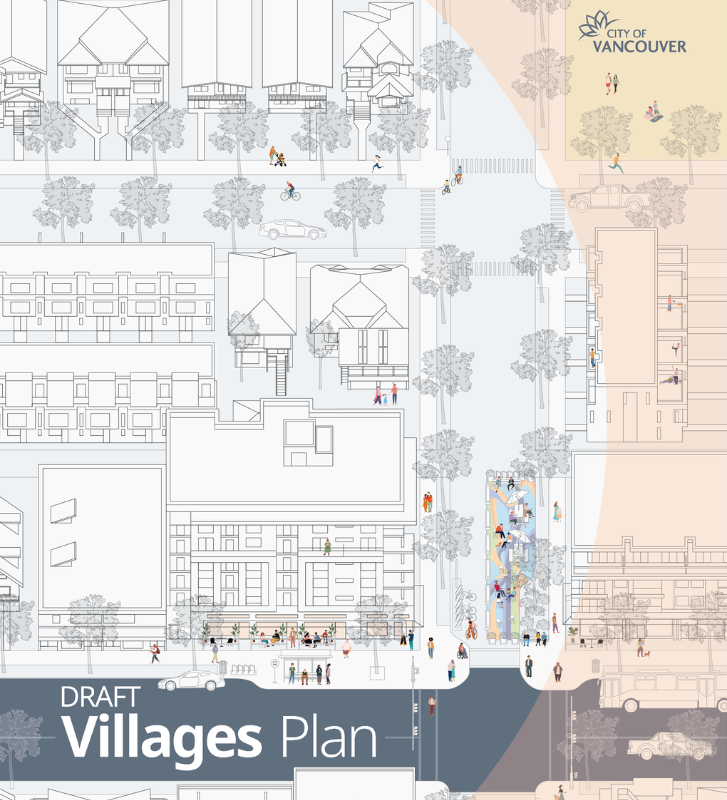
The city has chosen 17 intersections around Vancouver where a scattering of shops already exist for its new villages plan, targeting single-family neighbourhoods. New zoning would beef up the density of those small commercial strips, and open up many more blocks of residential for low-rise condos and apartments. The city says around 600 blocks will be impacted. The proposal, which is part of the official development plan, has been referred by council to a future public hearing.
In the meantime, the idea of dropping pockets of density into the city’s quietest areas has gained its share of skeptics. While many might envision a village as a charming high street or public plaza with community amenities where people congregate—such as a library, community centre, post office or pub—the Vancouver definition of village promises bigger buildings, denser streets, wider sidewalks and patios, and a short walk to conveniences.
Morgan Pitcher, who posts about Vancouver civic issues through his @uncouver TikTok and Instagram channels, has become a popular critic of the city’s ever-evolving policies. He doubts that city hall’s concept of a village will match his own. Small shops, he says, choose low-traffic locations for a reason.
@uncouver Everything you’ve heard about Vancouver Urbanism is wrong. it’s all about money. #vancouver #dtes ♬ original sound – unCOUVER
“These small businesses, they kind of look for these out-of-the-way commercial areas, because really those are the only places that are old enough to have rent cheap enough that they can maybe afford,” says the 31-year-old Pitcher. He himself lived in a rental apartment in Vancouver’s Marpole neighbourhood before relocating to Tsawwassen.
“When you upgrade all these areas, and build a five-over-one or whatever with retail on the bottom, it’s just going to be a Rexall or a Shoppers Drug Mart or a Fresh Slice. That doesn’t really contribute to vibrancy to me.”
Of course, the policy is in part designed to generate affordable housing, particularly within detached-house neighbourhoods that are out of reach for the average income earner. While most of the housing will be market rate, there will be a below-market component. However, the city’s definition of “affordable” hasn’t always aligned with what residents can actually afford. The city uses a definition that sets one-bedroom rents for $1,488, for “moderate” incomes of up to $84,780. For low-income earners, or those in the bottom 20 percent bracket, the options are pretty much non-existent, according to Canada Mortgage and Housing Corporation.
“Where’s the framework for affordable housing?” asks Robert Renger, a former senior planner for the city of Burnaby. “In concept, some of these ideas make sense. But then the way they implement them, with the top-down, one-size-fits-all, and without working in the most basic community amenities, or even schools and more parks, they’re just increasing the density. It’s a super simplistic approach to, ‘Let’s push in as much housing as we can, anywhere,’” he says.
“In fact, they’re going to be putting more pressure on the amenities that already exist.”
Neil Hrushowy, the city’s director of community planning, says the plan isn’t all about market-rate condos and townhomes. Rather, he writes in an email, it opens the door to “housing choice and inclusivity,” including opportunities such as co-ops, social housing and partnerships with nonprofits. And, by pre-zoning large areas, there won’t be that pressure to assemble properties and drive up prices, he adds, referring to a common practice that can be seen around the Cambie Corridor.
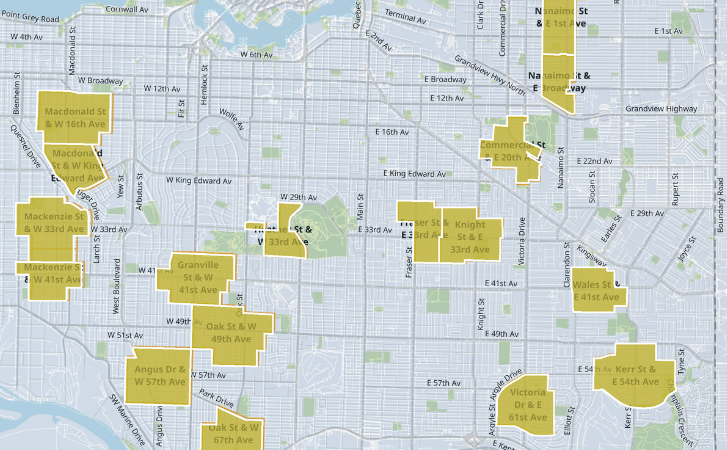
Former senior city planner Christina DeMarco worries that the villages are going to take away from neighbourhood centres, such as Dunbar and Point Grey, whose high streets are already suffering from vacancy rates of around 15 percent. Four of the proposed village sites are within walking distance of Dunbar’s high street. DeMarco points out that the Safeway store in Point Grey Village closed in 2018 and likely won’t reopen any time soon. It’s been a major loss for the high street, which saw stores empty out over the following years.
“My biggest concern is that they are not taking care of the neighbourhood centres, and the important role they play,” she says. “From a convenience point of view and a transportation management point of view, it makes much more sense to get everything you need in one place.”
Scot Hein, a former senior city urban designer and adjunct professor at UBC, shares a similar concern. Hein says Vancouver is a “city of distinguished neighbourhoods,” and believes that city staff should work with local communities for guidance, the way city planning worked for decades. That means a lot of in-person meetings, co-designing neighbourhoods with the help of residents and shop owners, and literally sketching out designs for streets and gathering spaces. The best way toward successful density, says Hein, is through community engagement. In an article for the urbanism website Spacing.ca, he wrote that the villages program is a moment to return to that grassroots engagement.
“I do not know if any of this work was done in person, rolling up sleeves and setting out draft mini-frameworks,” Hein tells BCBusiness. “This should be the first step in building trust.”
Andy Yan, director of the City Program at Simon Fraser University, calls it “a preoccupation with zoning as opposed to working with community.”
Hrushowy says that villages aren’t intended to take away from existing neighbourhoods. Rather, they’re enhancing what’s already there.
“They’re designed to build on and strengthen existing ones,” he says. “The plan focuses on making neighbourhoods more complete by adding a wider range of housing and bringing more shops and services closer to where people live.”