
When Kevin Huang became a first-time father in 2020, he was surprised by how unsophisticated his new, state-of-the-art stroller felt. The Vancouver-based software consultant and his wife, Anne Hunger, had spent more than $1,000 on the gold standard for strollers—an Uppababy—for their newborn daughter, Sophia, only to wrestle with the same frustrations that parents have faced for decades.
Living on a steep hill, Huang found himself gripping the stroller “for dear life” during late-night walks, worried that a momentary lapse would send it rolling downhill. “Every form of transportation has been motorized,” he says. “Cars, buses, scooters, bikes—anything where you need to move something, there’s some kind of assistance. Yet it was not implemented in something that carries our most precious ones.”
View this post on Instagram
The disconnect seemed even stranger when Huang looked at how far automotive technology had already advanced. Features like hill-assist braking and autonomous navigation had existed for years, but none had made their way into the stroller space. Digging deeper, he discovered that other parents were searching for smarter solutions too. A now-defunct crowdfunding campaign to develop a “smart stroller” had already convinced people to put up thousands of dollars on little more than a concept. “People were paying over $3,000 for an idea,” Huang recalls. “So we were like, okay, maybe there’s something there.”
Huang and Hunger set out to build a prototype for the stroller of their dreams. Their initial proof of concept was decidedly low-tech: a remote-controlled electric skateboard attached to their Uppababy with a rope. It worked. “As soon as I walked, it moved. When I stopped, it stopped too,” Huang recalls. “It stopped on a hill where I didn’t have to touch it.” What began as a backyard experiment soon became Glüxkind, the Vancouver-based startup Huang and Hunger founded in 2020 to reimagine the humble stroller. Inspired by the German word glückskind—“glück” meaning lucky and “kind” meaning child—the company’s name translates to “lucky child.”
Three years after those first experiments, Glüxkind unveiled Ella, an AI-powered stroller that debuted at Las Vegas’s 2023 Consumer Electronics Show—one of the world’s largest and most cutting-edge tech trade shows—with the price starting at $7,000. Since then, the company has expanded the lineup with Rosa, a more accessible model starting at just over $2,200. While it trades some of Ella’s futuristic bells and whistles for a lower price point, Rosa retains the features parents are most likely to use every day.
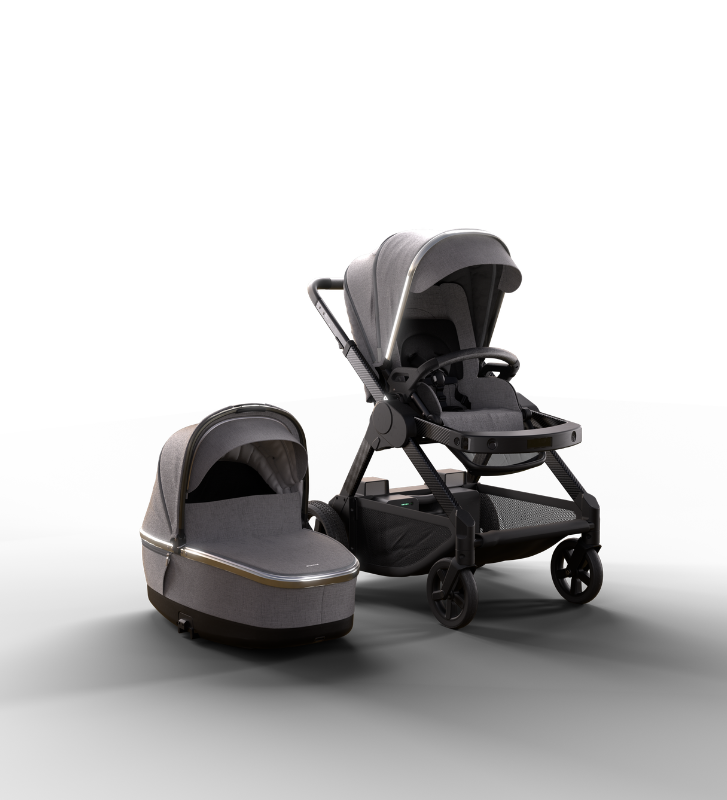
Dual motors help power the stroller up hills, while an intelligent adaptive braking system automatically stops it if a caregiver lets go of the handle. Reach into a diaper bag, bend down to tie a shoelace or sprint after an older sibling, and the stroller stays put. It can even park itself. And if the child is safely in a parent’s arms or walking alongside, the stroller can be switched into a hands-free mode to have it follow behind. Using a network of cameras and sensors meant to serve as “an extra pair of eyes and an extra set of hands”—and inspired by self-driving cars—the device constantly monitors its surroundings and can alert parents to potential dangers, from approaching bikes and scooters to nearby vehicles.
Then there are the features aimed squarely at sleep-deprived parents. If a baby starts fussing, the stroller’s “Rock-My-Baby” mode can gently rock them back to sleep. Built-in speakers can play white noise, music or recorded stories from loved ones—allowing grandparents halfway around the world to read a bedtime story with the push of a button.
Building an AI-powered stroller is one thing. Convincing parents to put their child in it is another. “It’s one of those things that, as soon as you touch it, you understand it,” says Huang, adding that Glüxkind has leaned heavily on demonstrations rather than traditional marketing to build trust with its target demographic. At trade shows and product showcases, the company often lets the stroller do the talking—a “test driver” might roll it onto a steep hill, let go of the handle and watch as it automatically brakes.
The strategy appears to be working. Like many B.C. startups, Glüxkind found an audience abroad before it found one at home. Following its initial product announcement, the company earned a 2023 CES Innovation Award, generating global media attention and nearly $10 million in pre-orders and commercial interest. Since then, Glüxkind’s strollers have shipped to customers in eight countries, with families across Canada, the U.S. and Europe embracing the technology. Ironically, there are still only a handful of the company’s strollers on the streets of Vancouver.
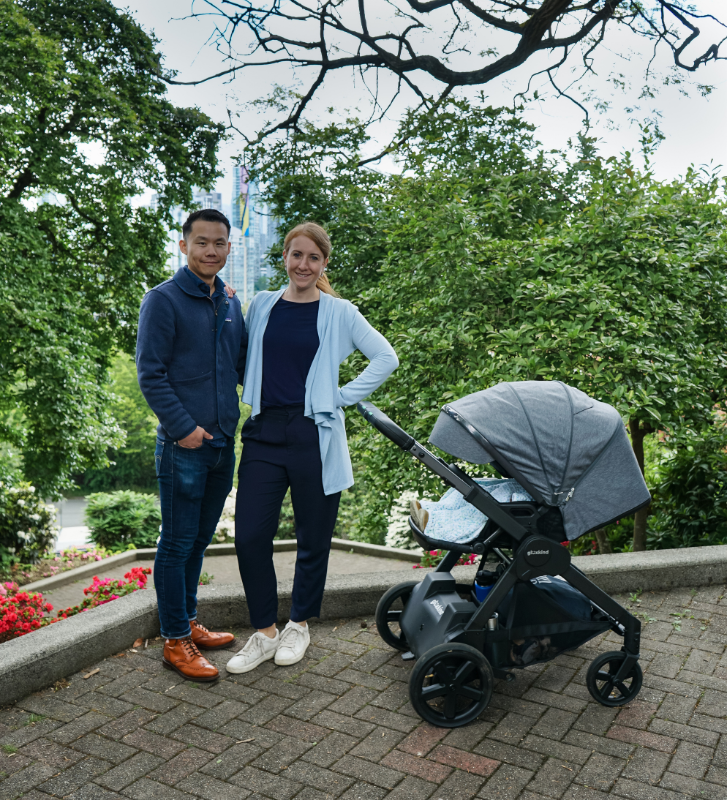
Scaling, however, has proven to be Glüxkind’s biggest hurdle. After spending nearly a year developing moulds and manufacturing processes, the company completed its first major production run of 150 units at the end of 2024—a key step toward bringing down the stroller’s hefty price tag through volume. But just as production was beginning to ramp up, trouble hit. Uncertainty stemming from shifting U.S. trade policies rippled through the supply chain, and one of Glüxkind’s key motor suppliers began downsizing before ultimately going under. The hardware startup was forced to spend months sourcing alternatives and re-engineering parts of the stroller. “It might look like a stroller,” says Huang, “but because it’s a quite complicated product, it’s not trivial to bring on these customized suppliers for these custom parts.” The disruption slowed production plans, though Glüxkind is now preparing to resume manufacturing at a rate of roughly 100 to 150 units per month, with ambitions to triple that output by next next year. Final assembly of the strollers—including their electronics and sensors—takes place in Vancouver, while other components are sourced through manufacturing partners in Asia.
To reach its production goal, the company is turning its attention to capital. Earlier this year, Glüxkind was selected as one of B.C.’s Top 25 Investible Companies, and it participated in Innovate BC’s Investor Showcase, an exclusive pre-Web Summit Vancouver event that brings together local and international investors to meet some of the province’s most investment-ready startups. The company has been largely bootstrapped to date, and Huang says the goal now isn’t additional research and development so much as scaling what already works.
For the dad-turned-founder, the company’s impact isn’t measured solely in units sold. Ella and Rosa receive over-the-air software updates, much like a Tesla, and new features continue to roll out long after a stroller leaves the warehouse—from an upcoming Spotify integration to community walking challenges. The company estimates that families using its strollers have collectively logged more than 2,000 kilometres of walking over the past year. More importantly, Huang says, they’ve reclaimed something even more valuable: time. Huang explains Glüxkind’s strollers have collectively logged more than 500 hours of soothing children through that automated rocking feature, freeing parents from the task. “That’s five hundred hours claimed back to themselves that they could have grabbed a coffee, had a nap, caught up on some sleep,” the founder-dad says.
View this post on Instagram
Behind those metrics lies the problem Glüxkind was built to solve. The village that once helped raise children is disappearing. Like many modern parents, Huang and Hunger found themselves raising children without the network of relatives and caregivers that previous generations often relied on. “A core part of your support is no longer there,” Huang says. “Everything that you do, it just becomes harder.” Glüxkind was born from that realization. Six years later, it is still building itself around a simple belief: every child deserves a village, even if it looks a little different from how it used to.