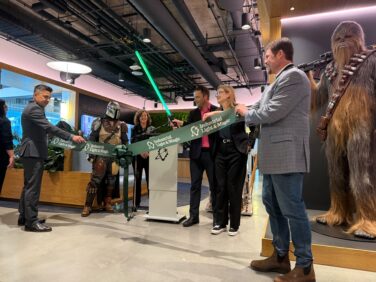

Robert Wong has seen it all.
When he joined BC Film—the provincial agency that would later become Creative BC—in 1998, there were no iPhones, and technologies like 3D printers and streaming channels had yet to become widely accessible. And vertical microdramas were still a generation away.
“I’ve seen a lot of changes through my time here,” says Wong, now vice-president at Creative BC and the man overseeing the province’s motion picture tax credit program. “Vertical production is another opportunity on the rise, and knowing the filmmakers and the production community here in B.C., it’s something that they’ll capitalize on.”
Mini soap operas shot in portrait mode, vertical microdramas deliver a steady stream of dopamine hits through fast-paced episodes rarely lasting more than two minutes, all engineered for binge consumption on a phone. In the United States, viewers spend more daily mobile time inside the top microdrama app, ReelShort, than they do inside Netflix, Prime Video or Disney+, and new apps launch every month. By the end of this year, the global market will hit US$14 billion—and a good chunk of that change is bringing much-needed work to Vancouver’s struggling film community.
Monika Dalman, a casting director who has worked on more than 100 vertical productions since 2023, estimates that at least 20 verticals are shooting in Metro Vancouver at any given time. Most are north of 60 episodes and filmed in under 10 days, with typical budgets under $200,000 per series—a fraction of a Vancouver-shot CW episode or Hallmark film, which can burn through that much cash in a matter of minutes.
“We’re scaffolding teams so that they can move from traditional film and TV into the vertical space, mostly because there’s not a lot of work right now in film and TV,” says Dalman. “But there’s also the timeline. If you have smooth development and pre-production, you could be delivering a product four or five months after the idea was conceptualized, where you could be looking at a decade in traditional film and TV. Right now people see that it moves so much quicker, so they want to get in. It’s been a bit of a mad gold rush.”
Flipping more than the script
In early 2024, Carin Smolinski answered an audition posted in a local Facebook group. A former actor who had returned to the business at 50 after raising children and developing private international preschools in Japan, she had no idea what a vertical was. “It took me five days into filming to figure out that the camera was sideways,” she laughs. “We were rehearsing a scene where I was running up the stairs with my character’s son, and he said, ‘Is this your first vertical?’ I thought he meant ‘vertical’ because the stairs were going up.”
Since that first shoot, Smolinski has gone all-in on microdramas, appearing in 29 productions over the past two years, usually cast as a scheming, wealthy matriarch, a mainstay character in a genre long on tropes and short on variety. But her future might be in advertising, as companies from Crocs to Procter and Gamble have begun producing their own microdramas as “branded entertainment.”
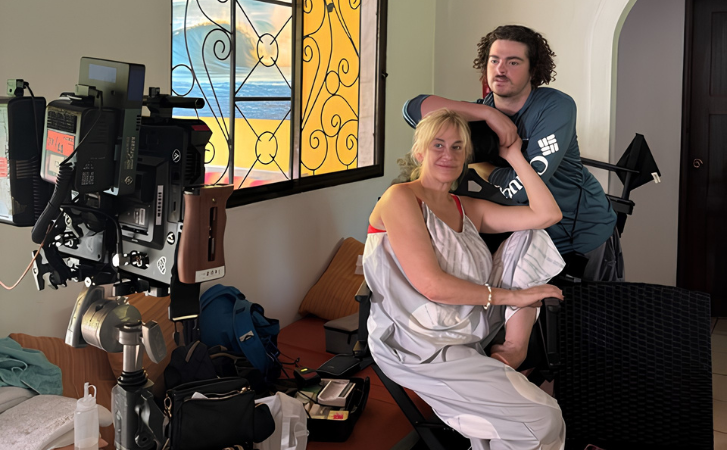
This is where Smolinski is placing her next bet. She says she’s now “exploring the world of branded microdramas” through her new venture, WEC Films (pronounced “we see films”), focused on creating drama series with brands woven into the storyline. “All of a sudden, we’re learning a whole new industry,” she says. “Working with brands, pitching to brands, learning advertising speak. The possibilities are endless.”
Here comes the boom
The flashpoint for the vertical microdrama was pandemic-era China, where producers serialized the redundant themes of online romance novels (billionaire CEOs, amnesia plots, Cinderella arcs) into minute-long episodes that viewers could unlock with in-app coin purchases.
By 2023, Chinese companies had shifted their sights to English-speaking audiences, with productions exploding in places like L.A., London and Vancouver. But the business of filmmaking rarely keeps pace with the speed of creative expansion, and B.C. producers found themselves battling old policy tools that don’t support the new wave of low-budget commuter candy.
“The tax credit programs don’t exclude vertical productions,” Wong says, “but there are some challenges for those types of projects to qualify.” The Production Services Tax Credit, which rebates 36 percent of B.C. labour costs on international shoots, has certain cost thresholds that all productions, including verticals, need to meet. The government’s Film Incentive BC program, aimed at domestic producers who own their intellectual property, requires a Canadian distributor, whereas most vertical platforms are headquartered in places like Beijing and Los Angeles.
Because current legislation in the province puts tax incentives beyond the reach of most verticals, the business is starting to leak to other provinces. “In Saskatchewan, PEI, Manitoba, the Yukon, the way their provincial tax credits and grants are written, verticals are allowed,” says Dalman. “We’re already seeing projects leave. Creative BC has been amazing—they are so supportive—but from a business perspective, that’s the missing piece right now.”
Dalman has spent much of the past two years scaffolding a new film community in Vancouver and across Canada since she cast her first vertical and saw the future of local filmmaking. In June 2025, she co-founded the a networking and advocacy group that’s raising the bar for professional standards on vertical sets. She also helped develop a vertical deal with UBCP/ACTRA, the union representing B.C. performers, putting Hollywood North’s first union-approved vertical series into development.
View this post on Instagram
Like any new medium, the bite-sized vertical format will remain a Wild West show until it finds its footing in the rapidly evolving mediaverse. Content still leans heavily on telenovela tropes—possessive alpha males, hostile takeovers, scorned lovers reappearing decades later to claim a billionaire’s inheritance—most of it written via formulas that are constantly optimized by platform data.
“We literally had to tell one writer, ‘You need to take out the intelligent part,’” says Dalman. “It sounds so negative and wrong, but the reality is it needs to be delivered to people in a way where these things are just obvious, because people are watching these to not have to overthink, as a way of escaping, to avoid mental exhaustion and fatigue. They don’t want to be unpacking something, they just want to relax and not think about it, just have the story delivered to them.”
Many independent filmmakers entering the scene want to expand the genre beyond its soapy roots, and the low financial barrier is giving them the chance to do so. “We’re trying to create something different, more cinematic,” says Smolinski, who wrote, directed, produced and financed her own tropical-surf-romance microdrama, Tides of Desire, which was shot over two weeks in Costa Rica. “The route forward is not there yet for independent creators, but I saw it as an investment in basically creating my own calling card. I’m not gonna just complain about content, I’m gonna do something about it.”
Business or bubble?
Even as independents are finding their niche in verticals, big players are piling on. Fox Entertainment has taken an equity stake in the Ukrainian studio Holywater, pledging 200 verticals in two years. ByteDance (TikTok’s parent company) has launched a competing app, Melolo, which calls itself the “home of hit CEO & Billionaire mini-series.” And Singapore-based DramaBox was one of four companies chosen for the 2025 Disney Accelerator.
But with platforms some analysts ask whether current growth is sustainable. Skeptics see a cautionary tale in the collapse of early vertical app Quibi in 2020, a fate microdrama producers hope to dodge with their cliffhanger storytelling, in-app purchase loops and built-in audience of hundreds of millions backing the model.
If the format survives, a bigger payoff may be heading Canada’s way. In March, ReelShort was added to the CAVCO list, the Canadian Audio-Visual Certification Office designation that qualifies a production as Canadian content. For the first time, a major microdrama app can officially serve as a Canadian distributor, opening the door to federal tax credits.
For Creative BC, this changes the math. Federal and provincial tax credits can stack up for vertical productions that meet the threshold—putting up to 46 cents of every dollar paid to a B.C. worker back in the production’s pocket. Now, more platforms are asking how they can get on the CAVCO list to increase Canadian production capacity, which will help Creative BC adjust legislation to keep pace with other provinces.
“We want to make sure we advise government as to what the trends are so that the policies can be reflective of the current production realities,” says Wong. “We always monitor what’s going on in the global market space, seeing how things are going, what are the trends there, where we need to step in.”