
It was raining when I got to the Helijet terminal at YVR, big drops of water soaking into my silk dress. Sure, it wasn’t the attire I’d usually wear when getting on a plane—yoga pants and loose sweaters would have been more par for the course—but on that particular fall day, I was flying private.
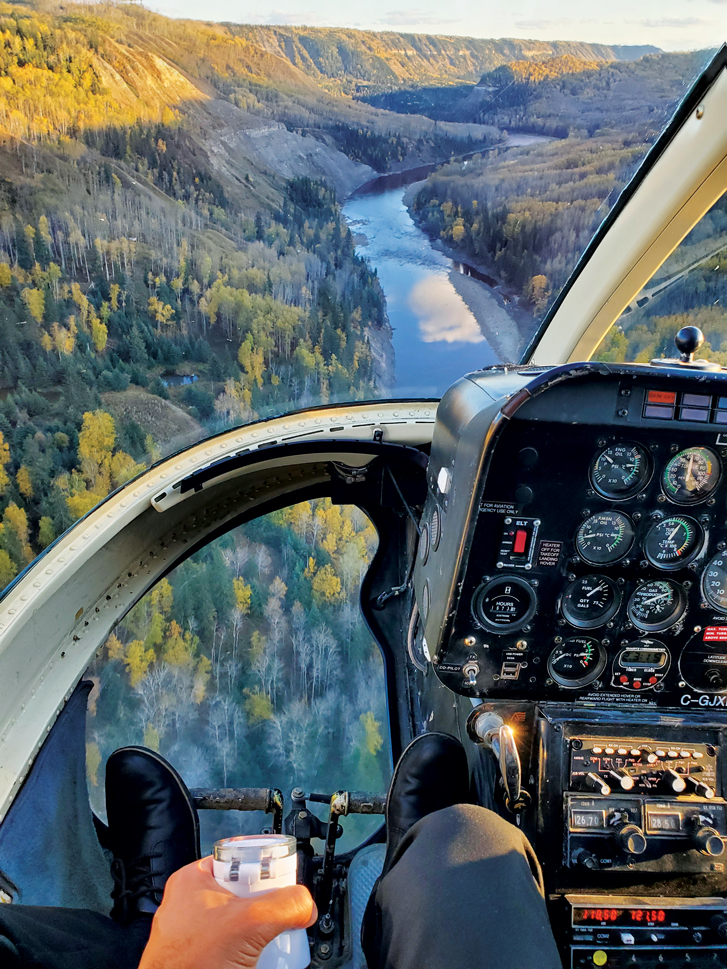
Thirty-five minutes later I was having iced coffee in the sun at an Okanagan café—far from Vancouver’s rain—on my way to a winery in West Kelowna, having miraculously skipped the four-hour drive up the Coquihalla Highway the trip would normally require.
The experience of changing locales (and weather patterns) drastically, in less than an hour and without the traditional airport hassle, is the convenient result of a much bigger idea: Airble, a B.C.-born aviation tech platform connecting consumers directly with available private flights.
It’s the solution to a problem that the company’s founder and CEO, Saeed Golzar, found himself dealing with in back in 2018 when he was stranded in Whistler, trying to get home to Vancouver. The commercial pilot was willing to charter a helicopter to get back to the city, but he was unable to simply book one. The inconvenience felt absurd to him. At that time, not even Uber was available in British Columbia.
“They say there are a lot of rich people in Vancouver. It’s a luxury city, but why can’t you book a helicopter?” Golzar remembers wondering. “I knew how many airports we had.”
At the time, Golzar— originally from Iran—was in the process of converting his commercial pilot licences to Transport Canada standards. He came to know the aviation landscape intimately: Canada has over 900 licensed air operators and more than 2,000 airports, heliports and water aerodromes (designated spots for seaplanes to land and dock), but the average person knows very few of them.
“We know [the major airlines] and that’s about it,” he says. “But there’s this entire parallel aviation economy sitting idle.” He made it his goal to connect the population to aviation operators through technology—the same way ridesharing platforms like Uber connect the population with drivers— starting with B.C.
Airble’s retail-direct model works by making use of “empty leg flights.”
When it comes to flying, every aircraft has a base, Golzar explains. When a charter is booked, the aircraft often must fly empty from its base to pick up passengers, then return empty after drop-off. The customer pays for all of those legs (plus landing permits, staff and additional premium services), which is why flying private is so expensive. Using Airble’s platform, consumers can find those “empty legs” and purchase them—for example, if I wanted to catch a private flight back to Vancouver after a day spent in an Okanagan vineyard, I could find it on Airble.
To charter that exact flight path might cost anywhere between $11,500 and $68,000 depending on the aircraft, but finding an empty leg on Airble could cost $3,150.
“The first customer has already paid for it,” Golzar says. “So why not use that empty time to create value for someone else?”
Downtime is unavoidable for some providers, so turning an idle aircraft into revenue beats leaving them on the ground.
“Why not use my aircraft when I’m available and when it’s on the ground for someone else to use?” asks Golzar as a pilot. “Sure, instead of $1,000, I make $950 and send $50 to Airble. That’s still $950 I wouldn’t have had.”
While many tour operators already partner with wineries, resorts, golf courses and lodges, Airble integrates those experiences directly into the booking system, allowing passengers to purchase aviation-and-experience packages in one transaction—kind of like Expedia does, but for private charters. For example, you could book a private tour of prehistoric glaciers and peaks, kicking off in Squamish, on a Cessna 172 for an upcoming anniversary.
The company also enables “jetpooling,” the aviation equivalent to Uber Pool. Users can signal interest in a route or experience, allowing the platform to match like-minded travellers who can then split the cost. With major global events like FIFA on the horizon, the demand for shared private flights is already emerging, says Golzar.
It’s this innovative thinking that earned Airble the Innovation Award at the BC Tourism Industry Awards in 2025, a recognition that Golzar feels validates his platform’s overall impact.
“A lot of operators in Canada are family-owned and Indigenous small businesses, often far from cities. What our platform does is not only onboard them, but we also sell their product and market for them so people know these places exist,” says Golzar. As of now, Airble works with 70 air operators across Canada (plus the U.S., Europe, Argentina, Mexico and Indonesia) , using more than 430 aircraft.
“I’m honoured [to receive] that award. If someone asks what Airble is, the answer would be a tourism-slash-transportation company. We are empowering tourism in British Columbia.”
As my flight touched back down in Vancouver after a day spent in the vineyard, I was welcomed home to the rain: a reality both sobering and hopeful. With a consumer-ready tech platform at my fingertips, even I (a life-long economy traveller) was able to access an industry as exclusive as private aviation.