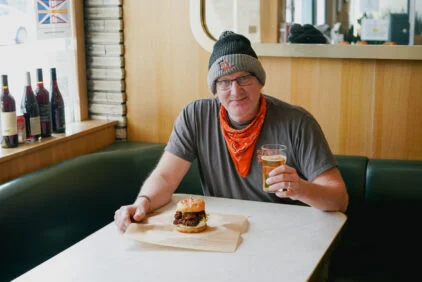

Pete Fry is Vancouver’s next mayor—and he has an ambitious to-do list for the city’s business headaches. In a landslide victory, the two-term Green Party councillor and veteran Strathcona resident defeated former mayor and incumbent Ken Sim in the October 17 municipal election.
Fry affirms that his background as a self-employed graphic artist makes him particularly attuned to the needs of Vancouver’s small business community, which has been increasingly squeezed by rising costs and red tape. Before entering City Hall in 2018, Fry spent his entire career “either running or servicing small businesses,” he told business leaders at the Greater Vancouver Board of Trade’s municipal election forum earlier this month.
The mayor-elect already comes with a strong track record of championing Vancouver’s hospitality businesses— having helped restaurants obtain dual food-primary and liquor-primary licences so they could double down on operations and services, as well as lifting the moratorium on new liquor-primary establishments in the Downtown Eastside.
Now, he’s striking with even bigger plans—from getting permits moving to giving stores a dedicated helpline when a street crisis unfolds. Here are six commitments Pete Fry made to Vancouver’s business community before winning the mayor’s chair.
1. Introduce a “business navigator” at City Hall
Figuring out which department handles what at City Hall has become a job in itself for business owners. A survey conducted by the Board of Trade ahead of the election disclosed that nearly half the businesses say that red tape is their top issue. Whether it’s adding seating or changing offerings, introducing changes can involve multiple departments, each with its own requirements for drawings, permits and safety approvals.
Adding that the business community’s request for this type of support had been heard “loud and clear,” Fry proposed a one-stop-shop “business navigator” to act as a defacto concierge – and give owners a consistent point of contact to help them work through those steps. The idea is to make it easier for business owners to understand requirements, costs and timelines—before committing time and money into procedures.
2. Fast-track change-of-use permits
A signed lease doesn’t necessarily mean a business can open its doors. Vancouver owners can spend “months upon months” paying rent while waiting for permission to use a space for a different purpose, Fry said.
He pledged to simplify and fast-track change-of-use permits, making it easier to turn vacant storefronts and underused commercial spaces into new businesses, services and community spaces.
3. Protect small businesses from property tax spikes
Fry flagged an impending problem for small businesses: the expiry of the city’s Development Potential Tax Relief Program, which reduces the tax burden on eligible properties assessed for their redevelopment potential rather than their current use.
View this post on Instagram
“We need a new tool to establish how we’re going to protect small businesses,” he said. “That’s a big priority for me.”
Fry added he had already asked the council to address the issue, but more work was needed to protect small businesses from rising property taxes.
4. Create a 24/7 response for non-emergency street crises
The GVBOT survey found that half its respondents think the city isn’t doing a good job on public safety. For business owners dealing with individuals in distress outside their storefront, Fry proposed an alternative way to get help: a non-police outreach team available around the clock.
Called CROW (Community Response Outreach Workers), the mobile team would provide a non-police, non-medical response to non-emergency calls involving people experiencing homelessness, addiction or other vulnerabilities. The aim is to connect people with support before situations escalate, while easing pressure on emergency services.
“Small businesses are dealing with street disorder and vandalism, and they have real worries about staff and customer safety,” Fry said. “We can preemptively address some of these crises.”
His broader approach to public safety includes expanding daytime services and shelters, giving people “places to go” and access to basic needs like toilets. He also called for operating conditions on supportive housing and overdose prevention sites to help manage their impact on surrounding streets. “You have more conditions right now to open a bar or restaurant in the city of Vancouver,” Fry said. “Yet we don’t put conditions on how we operate social services in the city of Vancouver.”
5. Introduce greater budget transparency
Fry wants tax increases to stay in line with inflation—but stopped short of promising a freeze. “I don’t want to promise what I can’t deliver.”
Instead, he made a detailed budget review one of his top priorities. “This last term, our budget’s been far too opaque,” he said, arguing that the document had shrunk from roughly 600 pages to about 24. “That’s not good governance, and that’s not how we run a city.”
Fry pledged to ask staff for a more comprehensive budget, with detailed line items showing where money is going and how fees are changing, before making further commitments on taxes and spending.
6. Use the city’s $800-million purchasing power to support local businesses
City Hall is a big customer—and Fry wants more of its spending to stay close to home. His “Buy Vancouver, Build Canada” strategy would use the city’s nearly $800 million in annual purchasing to support Vancouver and Canadian suppliers wherever legally and financially feasible.
The plan includes prioritizing B.C. mass timber and wood-frame construction in city projects and reinstating community benefit agreements on major developments to support local hiring and purchasing. It also proposes updating procurement practices to recognize Canadian value across sectors including technology, food and clean energy.
“When City Hall spends public money, we should be thinking about the public benefit that money can create,” Fry said in an announcement. “That means good local jobs, Canadian businesses, stronger supply chains, and making sure more of the value we create stays here at home.”