
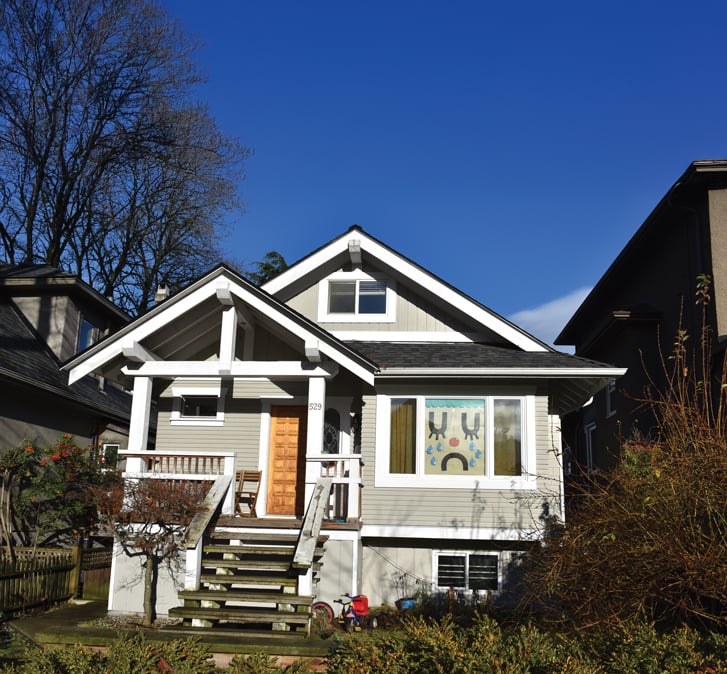
Rachel C. and her husband hadn’t planned on anything more exciting for their East Vancouver house in the 25 years they’d owned it except selling at the going rate once the kids moved out and buying something smaller.
Then real-estate brokers started calling in May 2022 to talk about acquiring her 1899 house as part of a deal aimed at assembling five lots that could be re-developed into a mixed-use development of up to 18 storeys under the Broadway Plan being talked about.
“They didn’t give us exact numbers, but the phrase was ‘Back up a truck with money to your front yard,’” Rachel recalls wistfully. A million dollars over the assessed value was the number floated at one point. They fantasized about buying a house in the suburbs with a pool. A commune for the whole family in North Vancouver. Or an apartment in Victoria and a pied-a-terre in Vancouver.
But then the brokers stopped calling, even though the Broadway Plan got approved at council that fall. Other deals near her seemed to be happening. One of Rachel’s neighbours on the next block sold her modest bungalow for almost double the assessed value in a five-lot land assembly. But the phone was silent at Rachel’s house.
Now she and her retired husband are in limbo. They don’t want to sell if there’s a possibility of some future buyout at a higher price than normal market. (Their house, which they bought for $275,000 in 1998, is currently assessed at just over $2 million.) And they’re reluctant to repair anything in the house except for the basics—including a broken kitchen drawer—if it’s all going to be torn down anyway.
“We’re just sitting here now. We don’t know what to do. The place is falling apart but I can’t bear to fix anything. I feel like we’re playing chicken now—who’s going to sell first?”
That scenario is playing out across many of the 500 blocks in Vancouver’s Broadway Plan, where the city’s biggest-ever mass upzoning in established central-city neighbourhoods has created a lottery of winners and losers among Vancouver residents.
Renters are caught up in it, too, with some lucking into a potential lifetime of subsidized rent, while others—not legally on the lease in their communal house or shared apartment, not eligible in some other way—have nothing to look forward to but eventual uncompensated eviction.
But it’s homeowners who are facing the most extreme financial swings. A few sold for casino-level winnings. Others have had their properties optioned and then un- optioned as development has slowed to a crawl in Vancouver, shackled by high land and construction costs, slow permitting times and declining rents.
And still others, with no offers, are living in a kind of fog, with a lot of uncertainty about whether their home will eventually be part of the lottery win if and when the real-estate market starts to function again, or whether it will actually decline in value as towers go up somewhere near them.
The sense of housing as something more than just a place to live has been a phenomenon for years in this rapidly morphing city, where real-estate gambling has become part of inherent local psychology. But it’s been more restricted in the past to limited sites or limited bursts. The Cambie corridor owners produced some windfalls 15 years ago, when that was rezoned for higher density because of the Canada Line coming in. And more than one homeowner in the past 30 years has cashed in bigtime by selling to an offshore owner or new immigrant.
The Broadway Plan super-sized that dynamic. The city’s new Villages plan will produce more of that phenomenon, but likely in a more orderly way as the city reverts to a system of clustering density tightly in certain key spots—around transit or commercial nodes—rather than randomly everywhere in a huge area.
“It’s a Catch 22,” says veteran realtor Marty Pospischil. “There are some winners and some losers.”
Pospischil says those who didn’t get to be part of a land assembly but now have the prospect of a 19-storey neighbour next to their Arts and Crafts bungalow will see an immediate effect if the tower proposed is right next door.
“It’s impacted immediately by half a million to a million because you immediately lose that sense of privacy in your back yard.”
He notes the highest-priced single-family homes are now those outside the city zones that have been slated for increased density (even though a multiplex could theoretically go up at any moment in those “safe havens” as well).
If it’s a block away, generally, the impact is less, except in one area, he said: Kits Point. Although it’s a few blocks outside the northern Broadway Plan boundary, it does have 11 towers at the Sen̓áḵw development theoretically going up nearby. Pospischil said he has seen properties go from selling at $3.5 million to not being able to get anything more than the high twos.
Corey Martin, at the R&D Group real- estate operation, says much the same.
“If a major development is going up next door, they’re definitely going to be impacted negatively,” is his assessment. “And it’s a pretty risky investment plan to think that, in future, someone else will come and offer a bag of money. So, the neighbourhood will still be desirable but it won’t be at a premium.”
Other realtors—and academics—are not so sure there’s such a direct impact.
Realtor Murphy Costello, whose own home on West 14th Avenue in Kitsilano is across the alley from a proposed tower, says he’s not sure how his value has been affected. Duplexes like his were selling for $3 million a few years ago. Now he thinks he couldn’t likely get more than $2.6 million. But he can’t tell if that’s definitely because of the tower proposal.
“It’s hard to tell if that’s the general market,” he says.
Tsur Somerville, a UBC professor specializing in land economics, also sees no definitive answer. “It’s been hard to figure out the effects,” says Somerville, who found in a previous study that a laneway house on Vancouver’s west side did produce a mild reduction in selling price for the homes that bordered that lot.
On the whole, he doesn’t think any Vancouver homeowner is ever going to lose, given that there will always be some people ready to pay handsomely to live in a single-family-style house close to downtown and in a transit- and retail-rich neighbourhood, no matter what’s around it.
“The potential decline in value by the density around you is more than offset by other factors. In the short term, there are winners and losers but, over time, they’re all winners.”
One proof of his hypothesis is the West End, Vancouver’s famously densest neighbourhood, where even being surrounded by towers hasn’t done much to seriously dent prices.
Paul Musgrove, a retired journalist, has lived near the intersection of Nelson and Cardero since 1971 in one of the few remaining single-family homes in the downtown-adjacent neighbourhood. His property, smaller than the standard 4,000-square-foot city lot, is still assessed at $2 million, down slightly from previous years but still more than 10 times the original purchase price. He’s not planning to move, so the only difference city rezonings and new towers in his neighbourhood make is more people using community centres, libraries and parks that aren’t getting expanded.
“I don’t mind them shovelling people in here if they provide services,” which isn’t happening, he observes. “The city loves densification, but they don’t like fixing anything.”