

Virginia Rodríguez Verdín Galeazzi first came to Vancouver from Mexico City on December 5, 2022. She was holding back tears the whole flight. She pulled her scarf high on her face to hide from flight attendants, to avoid any drama. She tried to show her four-year-old son, Elias, and her husband, Gerardo, that she was strong. It was a struggle to contain her emotions, however, because she had just left the life in Mexico she had known for 36 years. All she had in the world was packed on that plane, on three seats, in nine checked bags and a doggy carrier—Django, a big floppy-eared mutt, is family too. “I was crying inside,” Galeazzi remembers, holding her tears back again. She didn’t know what her future in Canada held. She still doesn’t know for sure.
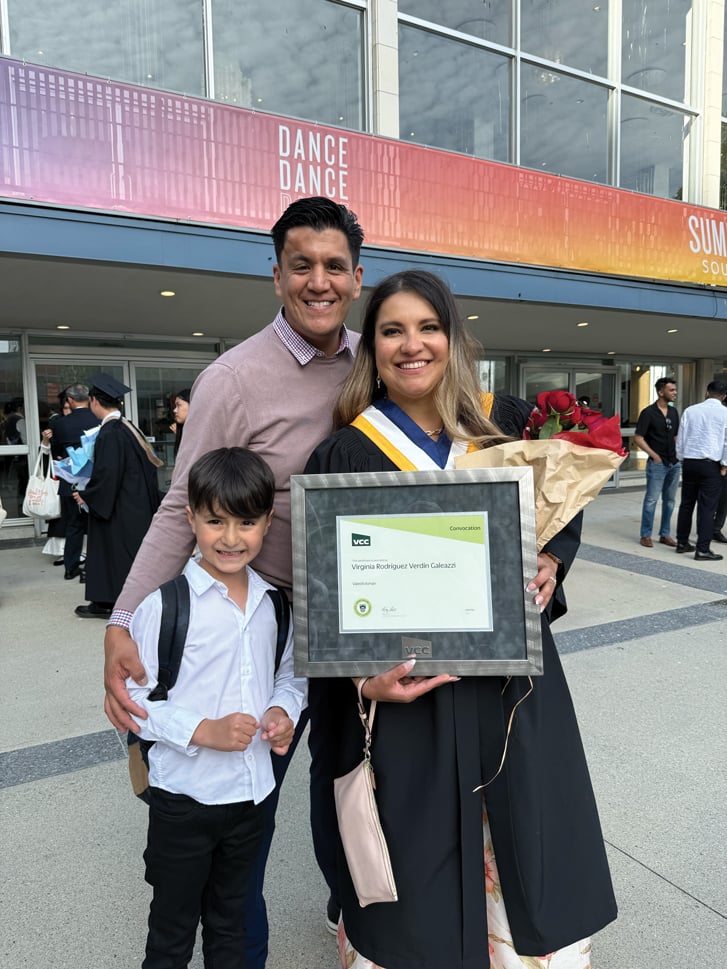
Galeazzi and her family came to Canada so she could do her MBA, although she eventually ended up studying hospitality management at Vancouver Community College. She would graduate with her diploma, giving her valedictory speech in December 2024. But her and her husband’s ultimate goal was to secure a life for their son safe from the cartel violence that has killed more than 30,000 Mexicans each year since 2018. They feared their child would become a victim in one of the horror stories they kept hearing about people they knew: “Oh, someone was kidnapped, someone was assaulted, someone was harassed, someone was killed,” Galeazzi enumerates.
She had enjoyed a career in the insurance industry before Elias was born. Her husband was an industrial designer. But when their baby came, they put family first and started making plans to leave everything else behind.
So for Galeazzi—like thousands of international students each year—studying in Canada became part of an implicit pact. She would help subsidize this country’s education system by paying higher tuition fees than domestic students. Later, she’d contribute her skilled labour to its workforce. In return, she’d earn a diploma or degree, and hopefully a post-graduation work permit (PGWP) that would give her family a toehold on the climb toward becoming Canadian.
Galeazzi and her family didn’t know they had landed in a political storm over students like herself coming into the country. She started classes in January 2023, becoming one of a record 1,040,985 international study permit holders in Canada that year. That was up from 301,545 in 2013. But, suddenly, Canadians’ welcoming attitude and federal immigration policies flipped.
The country’s population grew 3.2 percent in 2023. Too many non-permanent residents—international students and temporary foreign workers in particular—were arriving and straining housing affordability and public infrastructure, according to the federal government. The public agreed, with polls showing that a majority of Canadians believed immigration rates had gotten too high.
Immigration, Refugees and Citizenship Canada (IRCC) announced in January 2024 it would start capping the number of international student permits issued each year, along with other restrictions. This year, it reduced its limit to 408,000 permits, with 24,786 allotted to B.C. However, not all applicants are accepted, nor do they all come when approved. And students abroad seem to be getting the message: Canada doesn’t want you. While IRCC limited capped approvals in 2024 at 485,000, it only issued 293,220.
The policy is slowing the influx of newcomers as intended, but it’s causing whiplash for the universities and colleges in B.C. that have depended on international students’ higher tuition fees for funding. Most are laying off staff, shuttering programs and cutting costs by other means. B.C.’s minister of post-secondary education and future skills, Jessie Sunner, blamed Ottawa’s “unilateral” decisions for the turmoil, launching an independent review of the system last November, which is due to report this spring. The province’s schools are searching for ways to keep producing the skilled workers and business leaders that employers are asking from them.
These are broad, nationwide policy measures aimed primarily at alleviating big-city housing and infrastructure problems, but they’re landing with localized, unintended effects. Naturally, schools with programs that are popular among international students, like the hospitality management diploma at VCC, are experiencing sharp declines in enrolment. But the changes are challenging MBA programs in the province, too, despite the IRCC reversing the caps on graduate students it imposed in 2025.
The MBA program at the University of Northern British Columbia (UNBC) in Prince George is a long way geographically and in spirit from the shady Ontario schools that Immigration Minister Marc Miller denounced in his 2024 press conference as “sham commerce or business degrees that are sitting on top of a massage parlour that someone doesn’t even go to and then they come into the province and drive an Uber.”
“UNBC is a hiring pipeline for highly qualified people for business and industry in Northern B.C.,” explains Ronald Camp II, the founding dean at the university’s faculty of business and economics. Northern businesses can’t draw enough technical or management talent from Canadian cities like Vancouver or Toronto to meet demand. Small and medium-sized enterprises up to large companies like Kitimat’s aluminum smelter operator, Rio Tinto, are always searching for MBA-educated grads. UNBC’s solution: bring people in from abroad and educate them. “We can recruit international students who are willing to work in the North,” he explains.
IRCC’s caps are squeezing UNBC’s MBA pipeline, but, ironically, the cap numbers aren’t directly blocking any students. The ministry didn’t touch graduate study permits in 2024, included them as 25 percent of the total number of permits allowed in 2025, then exempted graduate students again for 2026. Policymakers may be indecisive, but prospective MBA candidates simply stopped trying to come. Camp says roughly 14 percent of program participants were international students before the cap was established. “What we saw was an 80-percent decrease in international applications,” he reveals. UNBC has put one of its MBA cohorts on hiatus and is holding off student recruitment while it makes strategic changes to its programming to make it more specialized toward the resource sector and other industries that are critical to the local economy and to the international trade partners it’s aiming to recruit students from.
The Gustavson School of Business at UVic has long specialized its programs, helping it weather some of these challenges. As a smaller school, it focuses its MBA programs on serving regional and Canada-wide communities and creating niche programs with partners. It brands its main MBA program as an MBA in sustainable innovation. It also offers a custom MBA in partnership with Telus, training its employees, as well as an MBA in advancing reconciliation in partnership with the B.C. Association of Aboriginal Friendship Centres. “We’re not a university or even a business school that has a high proportion of international students,” explains Graham Brown, Gustavson’s acting dean. “We’ve seen a dip, but I don’t think we’ve necessarily been as affected as some other places.”
Philip Steenkamp is president and vice-chancellor of Royal Roads University. He says he anticipated trouble three years ago—and knew it would be especially challenging for a small, special-purpose institution like his. The school cut costs by 10 percent and reduced staff by 10 to 12 percent over that time. Now, it’s looking for additional revenue streams.
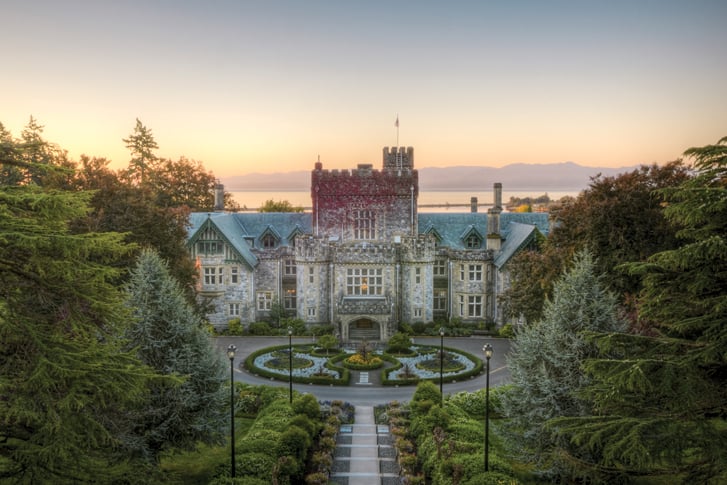
The Royal Roads campus used to play a different role—it was Professor X’s School for Gifted Youngsters in the X-Men movies. Steenkamp says the school continues to leverage its scenic location: “We’ve got a Netflix series that’s been filming the last few weeks. We had a big Disney movie. We’ve looked at increasing rentals. I think we did 60 weddings last year.”
And if restrictions keep international students from studying in Victoria, Victoria will come to them: Royal Roads opened a campus in the UAE last April, offering master’s and bachelor’s degrees in business, hospitality management and tourism. “Public universities traditionally haven’t been very entrepreneurial,” Steenkamp says. “And I think we have to get incredibly entrepreneurial right now.”
B.C.’s biggest university, UBC, may have more resources to help buffer it through hard times, such as its $4.3 billion endowment, but its administration is playing their cards close to their vest. In a statement, Matthew Ramsey, UBC’s director of university affairs, acknowledged a decline in international enrolment, and reduced staffing and operating budgets in some faculties. “The UBC Sauder School of Business continues to provide exceptional educational experiences for all of its students both international and domestic,” he noted. “Demand remains strong.”
Marvin Washington, the dean of SFU’s Beedie School of Business, says he’s concerned that domestic and international students may suffer if Canada continues shutting out the world. “Beyond the financial challenges due to the loss of international students on campus, I think the bigger challenge is the reduction of international perspectives in the classroom,” he says. “The world of business is inherently international and by reducing the number of international students on campus you are in effect reducing those voices and perspectives on campus as well.”
Indeed, what’s happening in classrooms today will inevitably affect the business world. BCIT has longstanding relationships with industry partners to fill labour market needs with its graduates. Jennifer Figner, the institution’s provost and vice president of academic, says many businesses don’t know yet what’s going to hit them—but they’ll find out starting as early as this year. “What’s about to start happening is the number of graduates is going to decline significantly, and industry is all of a sudden going to realize they can’t hire the people that they need,” she predicts.
BCIT has a mandate to train the province’s workforce, but demand for labour in several critical roles exceeds what domestic graduates can provide. International students used to enrol in programs that helped them fill those jobs. But in the 2024-2025, the federal government changed its eligibility requirements for post-graduation work permits, defining for the country which labour market needs were a priority. Figner says the feds missed the mark, leaving students in B.C. unable to get work permits in the areas they’re needed.
“The labour market in British Columbia is not the same as the labour market in Saskatchewan and is not the same as the labour market in Prince Edward Island,” she explains. “The provinces should be able to determine what their labour market needs are, and therefore which programs would have work permits that would feed those labour market needs.”
Vancouver’s hotel industry is already worried about losing workers. Bobbi Mand leads the hospitality management department at Galeazzi’s alma mater, VCC. She says more than 90 percent of her department’s students are international students. She also notes that this January’s student intake was slashed to just one set of 25 students, down from the usual four sets.
Mand says local hotels were already contacting them last year to interview students as labour shortages loomed and big events like FIFA World Cup 2026 approached. She started a letter-writing campaign to MPs when IRCC first launched its caps. She recounts her hotel partners eagerly jumping on board, telling her: “This is gonna affect us. We won’t have any employees.”
Galeazzi is grateful she arrived under the old rules, enabling her to study and her family to put in the hard work that’s still needed for them to earn permanent residency in the country.
She might have been in near tears when she arrived nearly four years ago, but her heartache turned to a smile as she felt cold snow falling on her body for her first time. Her family took a ride from the airport and started a snowball fight outside the Airbnb that was their home for the week. “I remember that we were laughing,” she recalls. “My son was smiling. And I said, ‘Okay. Let’s make this thing worth it.’”