
On a balmy 31-degree winter afternoon at Singapore’s Avant Marketplace, I’m standing in front of tanks filled with some of the world’s most coveted seafood: Australian rock lobsters, Alaskan king crab, Japanese Hokkaido scallops and oysters harvested just days earlier off Vancouver Island.
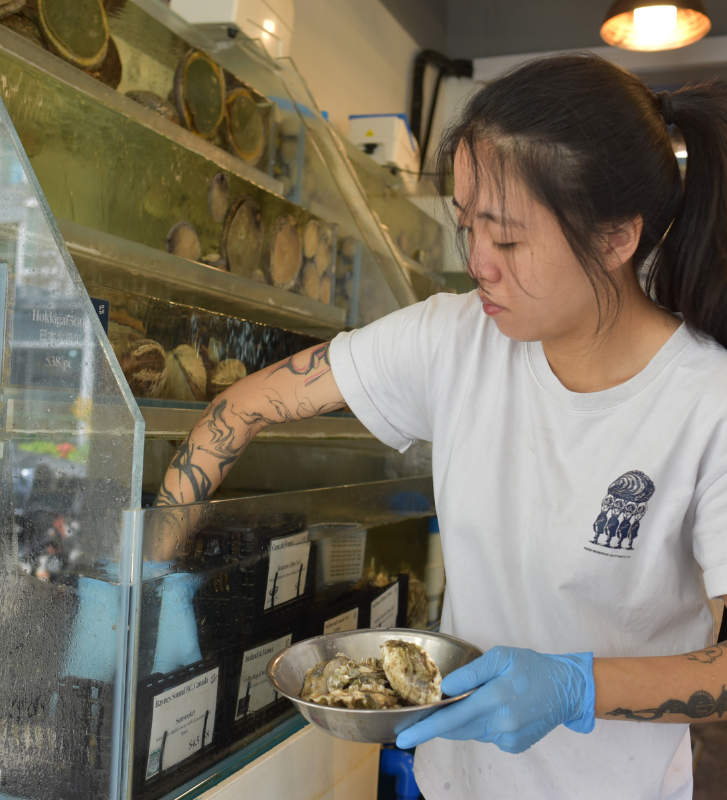
When my platter of freshly shucked Fanny Bay oysters arrives on the patio, they are sweet, briny and impossibly fresh. You would never guess they travelled nearly 12,000 kilometres to get here. These same B.C. oysters are a fixture across Singapore’s luxury dining scene, including on the raw bar at the Ritz-Carlton’s famed unlimited champagne brunch.
Shipments like this are increasingly routine as B.C.’s premium seafood flies across the Pacific through Vancouver International Airport, part of a fast-growing—and extremely lucrative—trade corridor linking Canada to Asia’s booming dining markets. But getting our local prized seafood onto diners’ plates halfway around the globe requires a carefully choreographed logistics chain involving fishing boats, refrigerated trucks, long-haul flights and two of the world’s most sophisticated airports.
The Air Bridge to Asia
At the centre of B.C.’s live seafood trade is YVR, where Tamara Vrooman, president and CEO, just committed to double air capacity volumes over the next five years. It’s ambitious:
Already Canada’s busiest hub for perishable exports, it handled a record volume of cargo in 2025, moving more than 365,000 tonnes of goods through its terminals (representing 7.4 percent year-over-year growth and the highest annual cargo volume in the airport’s history).
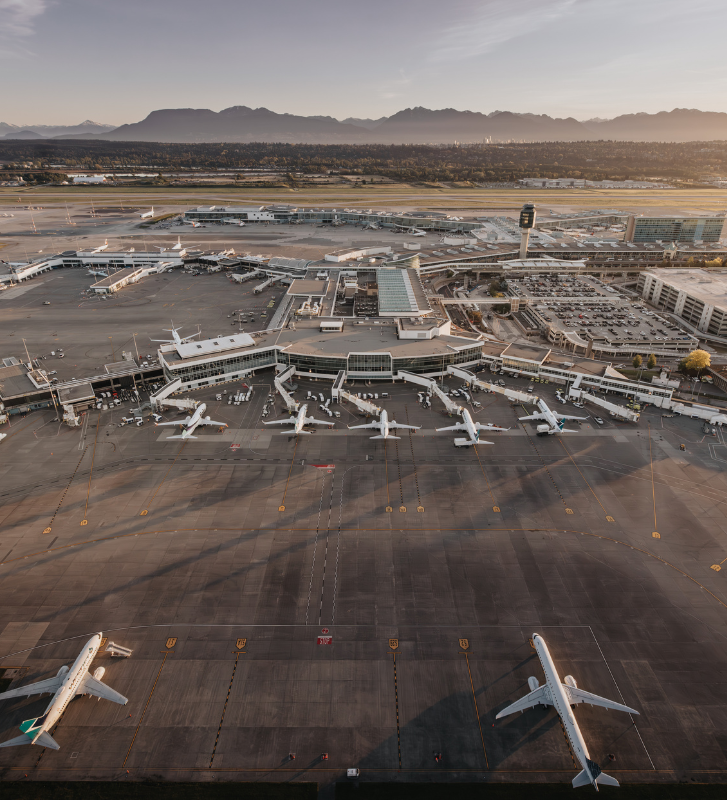
Unlike bulk commodities shipped by rail and container ship through the Port of Vancouver (which also just had a record year for shipping), the goods flying through YVR are much smaller in volume but far higher in value: electronics, medical devices, lab equipment, critical minerals and even gold regularly pass through. There’s also a huge volume of time-sensitive exports, like Okanagan cherries and blueberries, premium seafood (like oysters and sea urchin) and live crab.
“A Dungeness crab can go from sea to plate in Asia in about 72 hours,” says Vrooman. “That’s the level of freshness those markets demand.”
Since the launch of Air Canada’s direct YVR-Singapore route, exports of live Dungeness crab skyrocketed from $1 million in 2017 to $3.3 million in 2024, with shipment volumes nearly tripling over the same period.
Vrooman believes Canada’s growing push to grow exports outside of America is reshaping how the country thinks about its trade infrastructure. “We are the gateway for the nation,” she says. “If Canada wants to grow exports to non-U.S. markets, this is where a lot of that work happens.” Indeed, that growing export corridor through YVR is unfolding against Prime Minister Mark Carney’s aggressive and optimistic target to double Canada’s non-U.S. exports. Much of that growth is expected to come from the Asia-Pacific region.
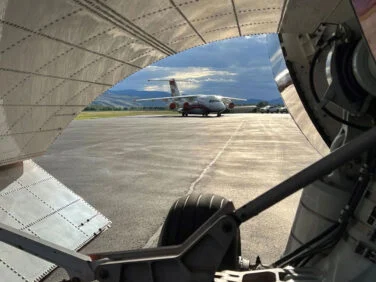
Most export goods flowing through YVR are travelling in a place most passengers never think about. “Sometimes people see a plane that isn’t full of passengers and assume it wasn’t full,” Vrooman says. “Trust me—it was full. It was just full in the belly.”
Those aircraft bellies have quietly become crucial trade corridors for Canada’s exporters. Roughly 65 to 70 percent of cargo moving through YVR travels on passenger flights, meaning every long-haul route across the Pacific expands the country’s export capacity.
It’s also why Vrooman is so keen to see Canada initiate new bilateral agreements and tourism arrangements, and to have more direct long-haul flights from YVR. “The more direct flights we have into Asia, the more opportunities Canadian companies have to get their products into those markets quickly,” Vrooman says, adding that YVR contributes or enables $13.48 billion in GDP for British Columbia each year and generates nearly $25.27 billion in economic output. Nationally, YVR’s GDP impact is even greater, at $15.8 billion.
And Vrooman argues that the airport is already prepared to take on more growth, citing major investments during the pandemic to infrastructure, operational resilience and digitization: “We don’t need to spend billions to expand our capacity.”
That readiness could prove critical as Canadian businesses look to diversify trade beyond the United States, reaching deeper into Asia—from established markets like Japan and Korea to rapidly growing economies such as Vietnam, where Vrooman is pushing for a direct flight option. “The demand to use YVR as a trade gateway is growing,” she says.
From Oyster Beds to Air Cargo
Fanny Bay Oysters has been exporting to Singapore for more than a decade, the relationship born from “boots on the ground” work in Asia that educates potential buyers on the delicacies being harvested from B.C. waters. For many years, Brian Yip, vice president of parent company Taylor Shellfish Canada, has hit the government-sponsored seafood trade shows in Singapore twice a year, often with a chef in tow to prepare dishes (“You can talk and show pictures, but to put food into people’s mouths is the best thing”). The shows created the key introductions to Asian buyers that helped get their oysters into seafood markets and retail stores. The five-star restaurants followed.
“Canada as a brand has a really good reputation in Singapore, particularly B.C.,” Yip explains, adding that, thanks to proximity, the Singapore trade shows are also key for meeting potential customers from Philippines, Thailand and China.
Buyers are impressed, he says, by where the oysters are harvested: clean, protected waters, free from pollution and heavy industry.
From an export attractiveness standpoint for B.C., Singapore has a lot going for it. It’s politically stable, has one of Asia’s highest levels of GDP per capita and boasts an affluent population that has high levels of disposable income. (At $6 to $12 a piece in the consumer marketplace, those oysters aren’t cheap.)
After harvest on Vancouver Island farms, Fanny Bay’s oysters are sorted and processed at a Canadian Food Inspection Agency-certified facility before being packed into insulated wax boxes with gel packs to maintain the cold chain. Refrigerated trucks transport them overnight to Vancouver, where they catch pre-dawn flights across the Pacific. At peak season around Christmas, Yip says, the company can ship as many as four 1,500-kilogram containers per day. Freshness is everything. Some oysters are airborne less than 24 hours after being pulled from the water.
Canada’s Pivot to Asia
The PM’s challenge to double exports from Canada to non-U.S. nations was a hot topic at this spring’s Canada-in-Asia Conference in Singapore, where business leaders, diplomats and policymakers gathered to strengthen ties between Canadian exporters and Asian markets. Organized by the Asia Pacific Foundation of Canada—the country’s only dedicated organization focused on strengthening relationships with Asia—the event drew roughly 660 attendees from across the globe with about one-third travelling from Canada.
The goal is simple: create the networks Canadian companies need to operate in a relationship-driven region—something CEO and president Jeff Nankivell, who spent 33 years in Canada’s foreign service, deeply understands about operating abroad. “There’s no substitute for being there in person,” Nankivell says. “If Canadian companies want to do business in Asia, they have to be in the room, building those relationships.”
Infrastructure plays a central role in that effort. “We need to continue expanding passenger capacity and air connections,” notes Nankivell. “When those flights grow, the cargo capacity grows with them.”
New trade agreements could accelerate that shift. Negotiations with India as well as the Association of Southeast Asian Nations, or ASEAN (which includes Indonesia, Malaysia, the Philippines, Singapore and Thailand), are expected to advance this year—deals that Nankivell says could unlock new flows of business travel, investment and high-value exports across the Pacific. Already, the ASEAN states together represent Canada’s fourth-largest merchandising trading partner, across sectors including raw critical minerals, clean tech, agriculture, financial services, aerospace and infrastructure. The impact is staggering: the Indo-Pacific represents Canada’s second-largest regional merchandise export market after the U.S.—valued at $262 billion.
Export Development Canada is also seeing the shift firsthand. Scott Moore, the agency’s chief financial and operating officer, says the Asia-Pacific market has become one of the most important fronts in Canada’s push to diversify trade. In B.C. alone, EDC works with roughly 3,000 exporters representing about $10 billion in trade. “We used to have to explain why people would consider Asia. Now the conversation is, ‘Tell me more,’” Moore says.
According to Export Development Canada’s latest Trade Confidence Index, 65 percent of Canadian exporters plan to enter new international markets within the next two years, with Asia-Pacific among the top targets. The shift is already underway: the share of companies exporting exclusively to the U.S. has fallen from 62 percent a decade ago to 34 percent today, reflecting a growing push to diversify beyond Canada’s traditional primary market.
Inside Asia’s Logistics Machine
On the other end of the corridor sits Singapore’s Changi Airport, one of Southeast Asia’s largest logistics hubs. In this maze of warehouses, loading bays and service roads where forklifts zip between refrigerator trucks and workers in high-visibility vests, it takes us more than 10 minutes to drive end to end across the 8,000-square-metre cargo complex—a telling measure of its scale. Exports from Canada to Singapore through Changi are substantial, valued at $2.2 billion by the feds last tally.
During my two-hour tour, the variety of cargo I saw was striking: stacks of Samsung boxes from Korea, crates of New Zealand apples and even a very friendly golden retriever being gently guided toward its next flight, to Thailand. Some of these goods trace surprising roots. While this is the final stop for the Fanny Bay oysters, other Canadian exports, including geoduck and scallops, often pass through Changi before continuing on to the growing markets of Malaysia, Indonesia or Vietnam—a circuitous route that Canadian officials say is evidence of the growing need for more direct flight connections to make trade more efficient and to cut delivery times.
Eric Kim, Cathay Pacific’s area cargo manager for the Pacific Northwest, oversees the up to 17 cargo shipments out of YVR weekly, many packed with shellfish, fresh and frozen fish, pork, fruits, veggies and dairy, headed to Shanghai, Hong Kong and Singapore. He says moving seafood across oceans comes down to two critical things: “Timing, timing, timing—and temperature control.”
The Economics of Exporting
For many B.C. seafood companies, access to Asian markets determines the fundamental economics of their business. Organic Ocean founder Dane Chauvel has built an entire business model around shipping premium seafood by air. (He’s not alone: of the 170 seafood processing companies in B.C. more than 110 are in the Lower Mainland, with a concentration in Richmond and Delta.) From Organic Ocean’s Steveston facility, trucks can reach YVR’s cargo terminals in 20 minutes. “It can be easier to ship seafood to Asia than to Toronto,” Chauvel says.
Instead of sending large containers, Organic Ocean ships smaller, high-value loads several times a week to destinations such as Singapore, Jakarta and Manila. “Our customers in Southeast Asia love that something that goes out today will get to them tomorrow,” he says.
Demand is strong, particularly for premium species like halibut, sablefish and spot prawns. But the economics of B.C.’s seafood trade often tilt toward Asia for another reason: price.
For manufacturers and wholesalers like Vancouver’s “seafood queen,” eatfish.ca CEO Jenice Yu, who supplies to high end restaurants, international markets frequently place a higher value on B.C. seafood than local buyers do. “In plain English, the local market doesn’t want to pay the price that international markets are willing to pay,” Yu says, using the examples of sea cucumber and geoduck.
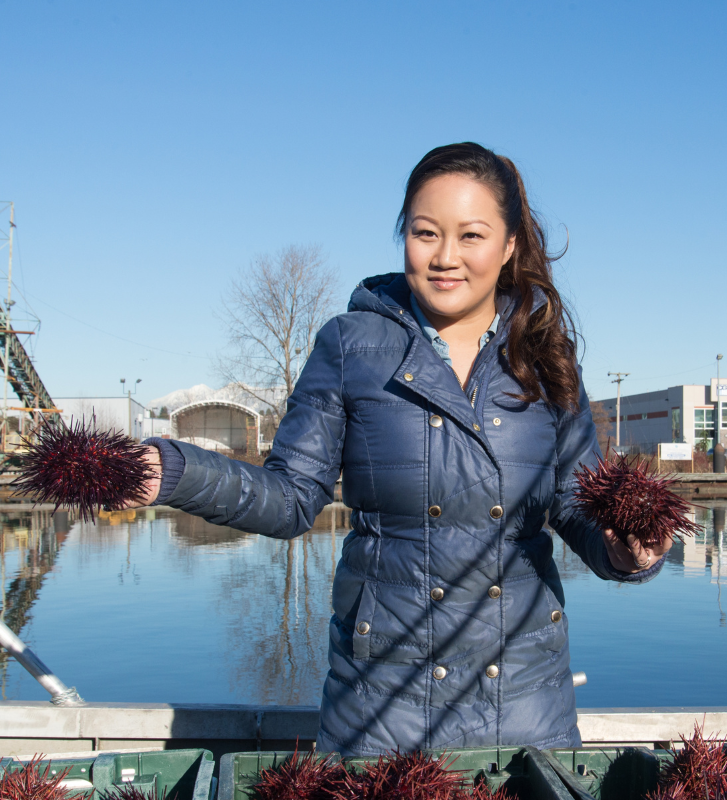
But the global seafood trade is also increasingly tumultuous, given the current state of tariffs. Katie Lindsay, marketing manager with the Underwater Harvesters Association, says Asia remains the dominant market for some species, including sea cucumber and sea urchin (which is “having a moment” right now in the foodie world, with demand skyrocketing in Europe, says Lindsay). Roughly 90 to 95 percent of B.C.’s geoduck harvest is exported to China, where it’s a familiar delicacy. If you’ve ever seen a three-pound geoduck, you realize that the average person not familiar with it will not be purchasing the phallic-shaped giant clam on a whim at the grocery store. (“It’s presentationally challenged,” says Lindsay.) “Trying to keep a little bit here, selling them piece by piece in the wholesale business locally, is just not as viable as shipping it all in a container and being done with it,” Yu explains.
Profit for geoduck dropped sharply last year—up to 50 percent—immediately after new trade restrictions were imposed. Lindsay notes that B.C. fisheries had little choice but to continue shipping at lower margins to finish their annual quota, but she is hopeful the next round of negotiations will open up their lucrative market once again. “We are so reliant on the Chinese market,” she says.
The $18 Spot Prawn
Back at Avant Marketplace in Singapore, manager and chef Zeena Ong is already looking ahead to B.C.’s next spot prawn season.
A short four-to-six-week commercial season combined with notoriously difficult shipping (spot prawns are extremely sensitive to temperature changes), these local gems are a hot commodity thanks to their scarcity—and delicacy (they are often eaten raw like sashimi because of their sweetness). Ong expects prices could reach $18 per prawn because of the premium import status. “People are willing to pay,” she grins.
So as long as aircraft keep leaving YVR’s runways bound for Asia, B.C. seafood will keep finding its way onto the world’s most expensive plates.
“We’re ready,” says YVR’s Tamara Vrooman.
And the world’s diners are waiting.