
The small building on Powell Street in Vancouver’s Downtown Eastside doesn’t look like the start of a small real-estate revolution.
But it is. The three-storey Powell Rooms near Oppenheimer Park, home to 23 people in its small rooms, plus a childcare program on the ground floor, will be the first building acquired by the recently created Downtown Eastside Community Land Trust by the time you read this.
The trust will hold it forever, with the aim of keeping tenants and childcare there at the lowest possible rates. And its advocates hope this is just the beginning of their acquisitions of low-income housing that will be preserved forever for the benefit of the community.
“This comes from an urge to try to do something other than just have the province buying buildings,” says Andy Bond, the executive director of the area’s land trust since 2023.
It’s the latest development in a movement that has been percolating steadily in Canada and the U.S. It envisions a different kind of nonprofit housing: one that isn’t the standard, government-subsidized social housing, isn’t supportive housing meant for the most challenged and isn’t co-op housing.
Instead, community land trusts, which have been springing up from Nova Scotia to Ontario to Alberta to here in the past decade, do things that those other, more familiar forms don’t.
Yes, the main idea (as with other forms of government-supported housing) is to provide places for people to live that aren’t part of the regular real-estate market, with the ever-present threat it poses of speculative buying, aggressive rental pricing and redevelopment that is not at all aimed at existing local residents.
But they’re also different.
They are committed to keeping forever any real estate they acquire. (Nonprofit social housing buildings can always be sold by the organization or their lease can be ended by the government that holds it.)
They are run by a group of people from the community, including neighbourhood residents and sometimes local business owners. (Co-op building boards are made up of residents, but don’t include anyone outside the co-op, which tends to produce a focus on mainly the functioning of their particular building as opposed to setting aside some of their units for, for example, youth out of foster care.)
And they can get big enough to develop a critical mass of resources that makes them more able to undertake property acquisition and development. (Again, small nonprofit housing organizations and building-specific co-ops don’t have that kind of heft.)
So far, B.C. has four community-based land trusts initiated by groups of local advocates and residents: the Downtown Eastside; Hogan’s Alley, whose group is working to re-create a hub for the region’s Black community on the edge of Chinatown; an Indigenous-focused one being spearheaded by Marcel Swain, CEO of the Lu’ma Native Housing Society; and South False Creek, Vancouver’s innovative housing development from the 1970s—plus an unusual giant Community Land Trust under the umbrella of the Co-operative Housing Federation of BC.
That trust, headed by federation CEO Thom Armstrong, helps small nonprofits, city governments, churches and other groups tap into a growing pool of resources and expertise when they look at developing or re-developing. Some smaller housing organizations have handed over their asset to the trust already, finding that it’s become too complex for a small group to manage and possibly re-develop. Having the provincial Community Land Trust negotiating with government works out better than having dozens of small organizations who aren’t very expert trying to do that job.
Armstrong thinks community land trusts are a powerful vehicle for developing low-cost housing that doesn’t just rely on giving massive amounts of density to private developers, which has been one of the dominant strategies in Vancouver and Burnaby in recent years.
“This is an opportunity for the public and private sectors to build out a much more robust nonprofit sector,” says Armstrong. If that nonprofit sector gets stronger, “I think we can do some things the private sector can’t do.”
The struggle that all community land trusts have, here and elsewhere, is that they’re a relatively new strategy that many, including government housing officials and people inclined to give money to worthy causes, are unfamiliar with.
The province has been cautious about backing the Downtown Eastside group, wanting to see proof that it has long-term stability and organizational capacity. So it has granted the trust the right to operate the Keefer Rooms in Chinatown, damaged by fire and currently being repaired, for two years and, if that is successful, will move on to helping finance a purchase. But it was not willing to provide capital for acquiring buildings yet. Vancouver city council also turned down a request for a proposed $1-million capital grant to help buy Powell Rooms, with members saying they didn’t really understand the proposal.
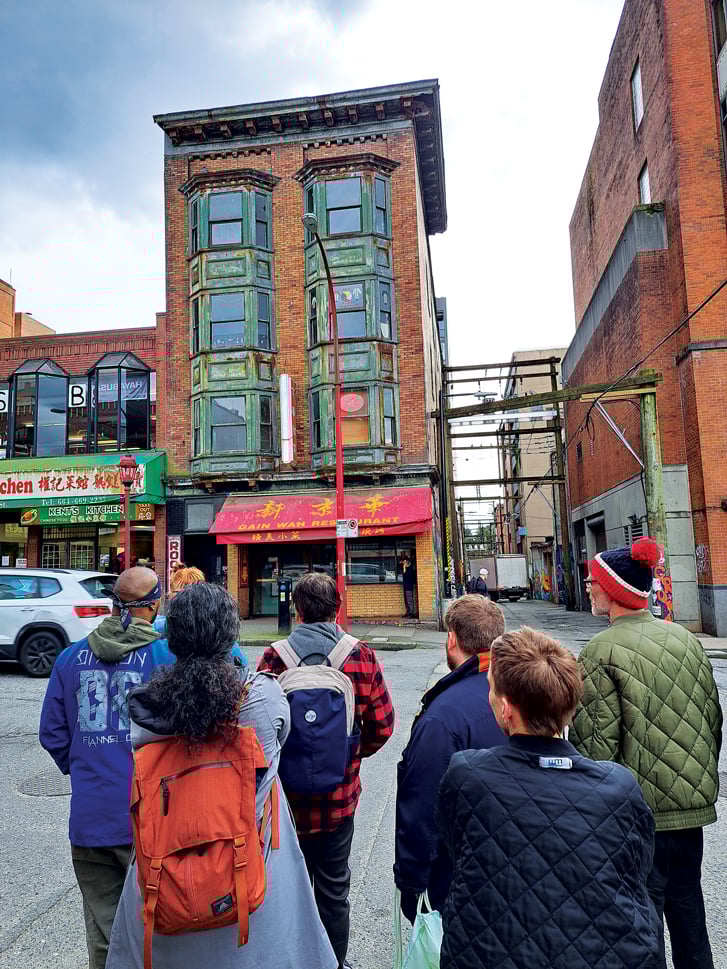
In spite of that, the Downtown Eastside trust did generate enough informed interest that it managed to raise the million it needed to buy the Powell Rooms from private donors.
(The Hogan’s Alley trust is moving ahead with a brand-new building at the corner of Main and Union, largely due to a $25-million mortgage granted by the federal government.)
But everyone working on this idea in B.C. is hoping that, soon, the province and various cities will start to catch on, as has happened in Toronto, which has seen neighbourhood and community land trusts spring up in several districts, including Parkdale, Kensington Market, Little Jamaica and Etobicoke.
The Parkdale Neighbourhood Land Trust is seen as an example to aspire to. It has grown very quickly, partly because the city helped out in various ways. Toronto city councillor Gordon Perks, using money that councillors there are allowed to spend any way they want in their wards, helped by allocating funds to acquire their first building.
The city also established a special fund in 2021—the Multi-Unit Residential Acquisition (MURA) program—that provides money to nonprofit groups trying to acquire existing cheap housing. So far, it has given out $165 million to almost two dozen groups, including community land trusts. The Parkdale trust now owns 86 buildings that house about 500 people. And, in November 2025, the city of Toronto chose that group to develop a 175-unit community rental building.
Wendy Pedersen, who has spent years working with low-income people in Vancouver’s aging residential hotels through the SRO Collaborative Society, is beyond excited about the idea of land trusts. It’s something she sees as the best option for salvaging the half of current residential hotels in the Downtown Eastside that are in reasonable condition.
“The thing about this model,” she says, “is that it really taps into the community’s own passions and interests.”