
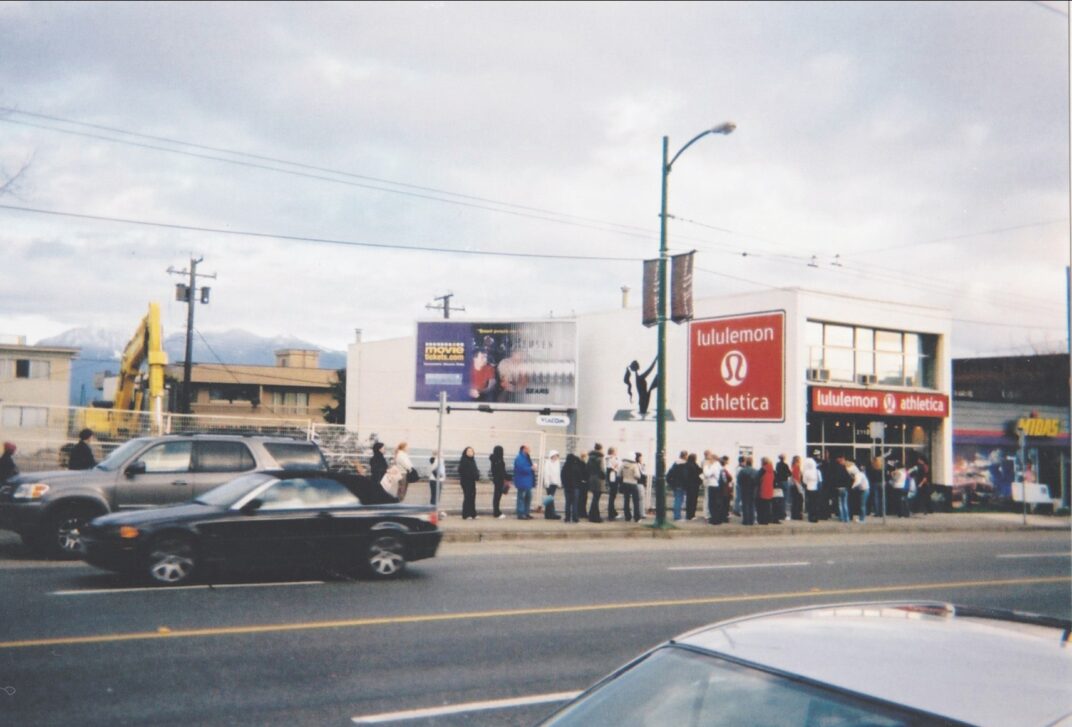
When Lululemon Athletica opened its first official store in Vancouver’s Kitsilano neighbourhood in 2000, its head office consisted of a one-floor space located right above the store. The then general manager of the store, Darrell Kopke, was one of six people making up the initial executive team, the same team that would “run downstairs to work on the retail floor and fold yoga pants when it got busy,” recalls Kopke, who is now a serial entrepreneur and faculty member at UBC Sauder School of Business.
Yoga itself was barely an industry then. There were only a few studios in Vancouver. Bikram Yoga was just beginning to take hold, and the idea that stretchy black pants could underpin a global business bordered on absurd. Even as Kopke wrote Lululemon’s first business plan in 2002, mapping growth across a few “compelling yoga markets,” he never imagined the brand would go on to become a cultural and commercial powerhouse valued at more than $20 billion (U.S.).
Nearly three decades later, the outline of an empire under pressure has come into view. In the past two years alone, Lululemon has been battered by a convergence of crises that critics and analysts now describe as signs of a brand in decline.
In 2025, U.S. sales fell, the company’s stock price dropped more than 50 percent and market value collapsed amid intensifying competition, higher input costs—including pressure from U.S. tariffs—and growing investor unease. The company’s controversial founder, Chip Wilson, escalated his long-running criticism of the leadership by taking out a full-page ad in the Wall Street Journal—“Lululemon in a Nosedive”—publicly attacking its strategy and agitating for board change. Weeks later, Lululemon announced that longtime CEO Calvin McDonald would step down after more than seven years at the helm, with chief commercial officer André Maestrini and chief financial officer Meghan Frank named interim co-CEOs as the board continued its search for a permanent successor. That search is already contested: activist investor Elliott Investment Management, which has built a stake of more than $1 billion (U.S.), is pushing for the appointment of former Ralph Lauren executive Jane Nielsen to the top role.
View this post on Instagram
In January, the company said it would cut roughly 100 jobs in its customer-care division, underscoring the operational strain now facing the business.
At the same time, former employees have come forward with accounts of racism, body-shaming and toxic workplace dynamics, complicating years of corporate messaging around inclusion and culture. Once the undisputed tastemaker of athleisure, Lululemon is now routinely described as culturally irrelevant and outpaced by newer athleisure brands like Alo and Vuori. So, how did it all come undone?
The answer may lie in how Lululemon Athletica rose in the first place. Kopke traces Lululemon’s early success to a rare alignment (and powerful trifecta) of timing, customer and strategy. The brand, he says, arrived just as the so-called “urban superwoman” was coming of age, offering a technically advanced fabric at the exact moment Wilson understood that vertical integration could unlock both control and margin. Layered onto that was a community-based marketing model that cultivated a tribe—bringing together like-minded, values-aligned customers through free yoga classes, ambassador programs, manifesto-adorned shopping bags and events that garnered a cult-like fan frenzy, like the SeaWheeze Half Marathon. As Lululemon went public in 2007 and expanded rapidly beyond Vancouver, opening stores in North America, Australia, Europe and Asia, that sense of community scaled alongside the business, turning a niche yoga-wear company into a global lifestyle brand and cultural icon.
By the time COVID-19 hit, Lululemon was already a well-oiled machine—and the moment acted as a powerful accelerant. Retail analyst Bruce Winder describes the pandemic as a “turbo thrust” for the brand. As work moved home and self-care became a cultural preoccupation, athleisure surged—and Lululemon, long positioned as both performance brand and wellness signal, benefitted enormously. A company that had once been heavily store-driven accelerated its e-commerce business at pace, with online sales, revenue and share price all climbing sharply. Pandemic-era demand delivered years of growth in a matter of months, fuelling double-digit annual gains—including a 61-percent surge in revenue in the second quarter of 2021 and annual sales that nearly doubled from about $3.3 billion (U.S) in 2018 to more than $6 billion by 2021—prompting significant reinvestment in digital channels. The momentum carried forward, with the firm’s stock closing at an all-time high of $511.29 on the Nasdaq at the end of 2023. For a time, Lululemon felt untouchable.
Former CEO Calvin McDonald’s tenure coincided with—and helped steer—this lucrative period in the brand’s history. After taking the helm in 2018, McDonald sharpened the company’s focus around three clear growth pillars: expanding menswear, accelerating international growth—particularly in China—and doubling its digital revenue. The strategy delivered. Revenue climbed year after year, margins held and the brand pushed confidently into new categories, including footwear, menswear and loungewear, while expanding its global footprint. “For a few years, Lulu was just rolling in terms of their results,” Winder says.
Just like the brand’s making was “a combination of the right product at the right time for the right customer told by the right people in the right way,” as Kopke believes, Winder see its recent downfall as “a comedy of errors, sort of a perfect storm of issues.” The fallout is evident in the market: after peaking in 2023, Lululemon’s stock slid sharply, falling as low as $159.25 on the Nasdaq in September 2025.
Culturally, too, evidence of the brand’s fading pull is easy to find online. Scroll through social media threads dedicated to Lululemon and the tone is blunt, even dismissive. One user recently described the product as “overpriced spandex pants,” while another questioned the value proposition altogether, arguing that comparable items can now be found at Costco for a fraction of the price—a claim Lululemon itself is contesting in court, having filed a lawsuit against the retailer over alleged knockoff designs. More recently, the company was forced to temporarily pull a new line of tights—“Get Low”—from its website after customers complained they were see-through and impractical for movement. Wilson called the moment “a new low” for the firm. Lululemon later re-listed the leggings with added disclaimers around sizing and undergarments, echoing a similar episode in mid-2024, when shoppers criticized a V-shaped seam on the back of another new release. The product quality concerns gained weight when chief product officer Sun Choe quietly exited the company in May 2024, with no replacement announced.
For Winder, the headwinds reflect a broader economic squeeze on the aspirational and semi-luxury consumer, where brands once able to command a premium are now being scrutinized more harshly. Kopke, meanwhile, sees the problem as cultural as much as economic. In his view, newer entrants—like Alo Yoga, Vuori, Aritzia and Skims—have siphoned off the brand’s edge, particularly among younger demographics. Alo, he argues, “stole the sex appeal from Lulu,” leaving Lululemon profitable, but no longer dominant in the cultural imagination.
The erosion of Lululemon’s edge has prompted a deeper critique of its strategy: that in trying to broaden its appeal, the brand diluted what once made it distinctive. As Winder frames it, the question is whether the brand tried to become “everything to everyone.” In hindsight, he suggests, restraint may have served the company better—staying relentlessly focused on execution, remaining best-in-class in its core categories and allowing international growth to do the heavy lifting. The ill-timed $500-million (U.S.) acquisition of connected-fitness startup Mirror in 2020, which was ultimately shut down just three years later, has become shorthand for that drift. Kopke is blunter. “The problem,” he says, “is you can’t articulate in one sentence what business Lululemon is in anymore.”
The question of a lost core is now playing out in a high-stakes tug-of-war between founder and major shareholder Chip Wilson and activist investor Elliott Investment Management. Wilson, who effectively controls roughly 8.8 percent of Lululemon’s outstanding shares—about 9.9 million shares held through family trusts and related entities as of December 2025—remains one of the company’s most influential stakeholders. He has used that leverage to push for a return to the brand’s creative roots and product-led ethos, launching a proxy battle aimed at reshaping the board. On the other side is Elliott, known for pressing underperforming companies to unlock short-term value. “It’s a bit of a battle of Godzilla and King Kong,” says Winder.
If Lululemon is searching for a playbook, Winder points to a familiar name much closer to home. Aritzia, he argues, has managed a balance Lululemon has struggled to strike—between investor expectations and consumer desire. The brand has expanded deliberately, posting strong results without trying to fundamentally reinvent itself. Rather than chasing every adjacent category or market, Aritzia has stayed tightly focused on design, pacing its growth and anticipating post-pandemic fashion shifts before they fully materialized. “They’re doing it slow and smart,” Winder says. “They’re expanding, they’re putting up great numbers—but they’re not trying to change what they are.” Indeed, the growth is evident. The homegrown retailer is set to take over the 40,000-square-foot former Nordstrom flagship in downtown Vancouver and also recently acquired the iconic L.A. brand Fred Segal.
Kopke widens the lens further. For him, the athleisure brands doing “authentic growth” right now aren’t necessarily the biggest, but the most specific. Gymshark, he notes, built its business around a tightly knit online community of gym-focused influencers, while newer players—like Rhone, Born Primitive or Wicked Rose—are deliberately going niche. Each is clear about who it serves and why. That specialization, Kopke argues, is precisely what’s eroding at Lululemon.
For all the turbulence, Lululemon Athletica’s underlying economics remain strong—its December 2025 earning report showed gross margins north of 50 percent and operating margins close to 20 percent. The brand also served as the official outfitter of Team Canada for the Olympic and Paralympic Games at the Milano Cortina 2026 Winter Olympics. In a statement to BCBusiness, the retailer confirmed its plans to “accelerate our U.S. business, maintain our international momentum and protect our operating margin with a focus on long-term improvement,” emphasizing its confidence in the current executive team as well as future opportunities for the brand.
Now, the athleisure giant remains profitable but without a clear sense of direction, as leadership tries to walk the tightrope between Wall Street expectations and cultural resurgence. Winder describes it as “floating a little bit without a rudder,” but still sees runway in its international markets. “It depends on whether they can get their act together to seize it,” he adds. Over the past year, Lululemon has signed franchise partnerships covering Greece, Austria, Poland, Hungary, Romania and India, alongside opening a new store in Milan—moves the company says will all include physical retail locations.
For now, Vancouverites and British Columbians are left watching—waiting to see whether our most famous export can still turn a setback into a second act.