
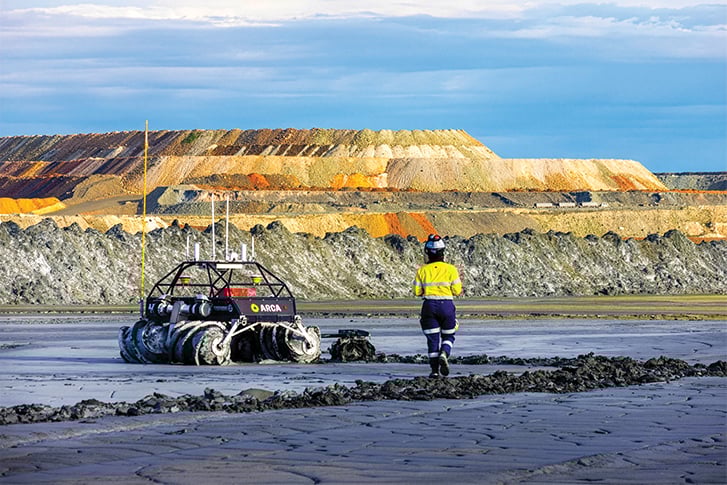
A few years ago, a cleantech startup from Vancouver caught my eye on LinkedIn. Arca had posted some videos of autonomous rovers resembling dune buggies. They had antennas to measure data and corkscrew-shaped metal wheels built to navigate the cracked, uneven surfaces of resource mines. They looked like Martians.
The rovers are a part of Arca’s efforts to turn mining waste into rocks that permanently remove carbon dioxide from the air. In 2025, the company completed an 18-month pilot project testing their impact on an active nickel mine in Australia. The results showed ten to 20 times more CO2 absorption in the area.
From its lab in Vancouver’s Mount Pleasant neighbourhood, Arca develops carbon dioxide removal (CDR) technologies that could help some of the world’s most emission-heavy industries switch sides in the fight against climate change.
When I finally get to see its solutions in person, I’m reminded of the Pixar movie WALL-E: the lonely robot trying to clean up a post-apocalyptic Earth destroyed by pollution and overconsumption. But unlike WALL-E, who toiled among humanity’s leftovers, Arca’s machines are intervening at a crucial point in time, turning mining waste into carbon sinks and helping place B.C. ahead of the curve in clean technologies.
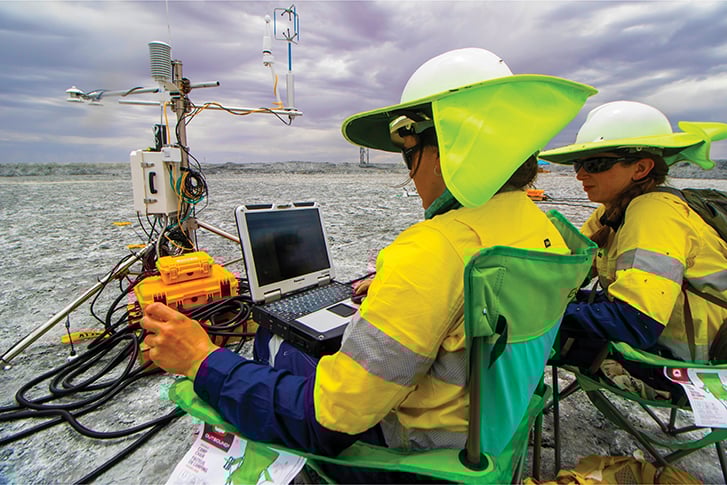
Greg Dipple, Arca’s co-founder and head of science, explains the three-part technology over a video call. The first is measurement. Arca’s rovers are equipped with sensors that monitor how much carbon is being captured. Dipple spent over 20 years at UBC studying how certain types of rocks—“ultramafic” rocks, which are high in magnesium and can be found in mining waste—naturally pull carbon from the air and lock it away for thousands of years.
The second part is “smart churning.” The rover plows the surface of mine tailings to expose deeper layers of rock to the air, speeding up the natural process of carbon mineralization—which is when CO2 gas is transformed into rock.
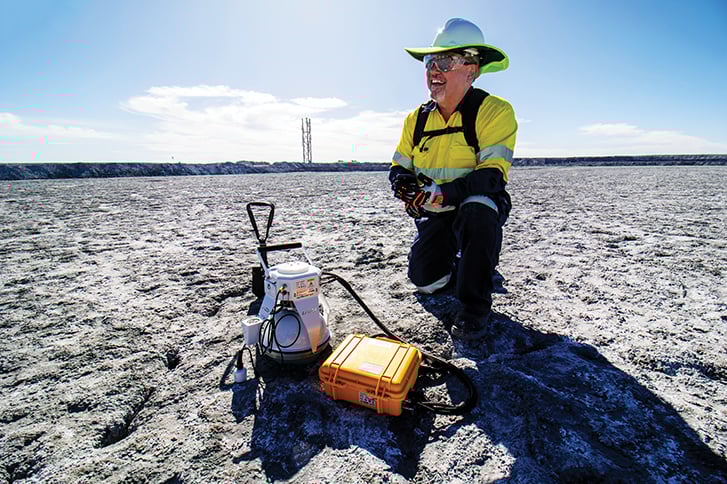
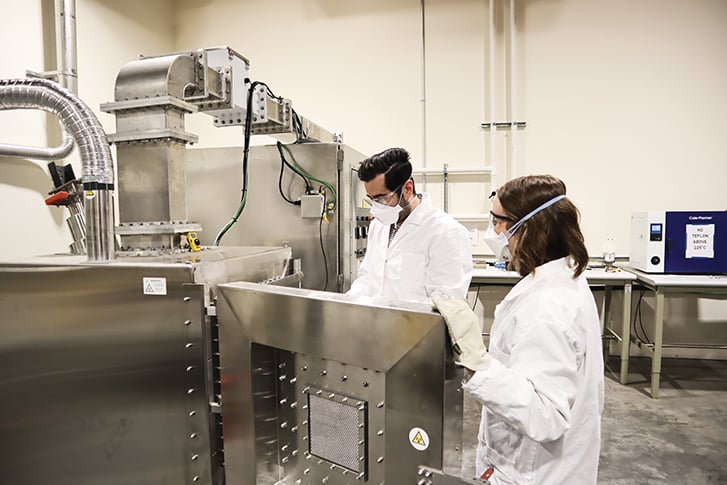
The third is mineral activation. “We’re essentially making microwave popcorn out of ultramafic minerals,” says Dipple, whose team is also developing a one-of-a-kind machine that uses microwave technology to dramatically boost the carbon capture capabilities of rocks. “We call that activation.”
Together, these technologies form the backbone of Arca’s business model, which revolves around generating verified CDR credits for industries looking to offset emissions.
Dipple met Arca’s other co-founders, Peter Scheuermann and Bethany Ladd, at UBC, where the trio was researching how CDR technologies could work hand-in-hand with mining operations. In 2021, the founders participated in a venture-building program at Innovation UBC (formerly entrepreneurship@UBC) and, the following year, Arca was officially in business.
“It has been quite the journey since we spun out from UBC—an entirely different ballgame,” says Ladd. “We’ve all been learning how to create a viable company from this research.”
Over the past few years, Arca has grown to a 27-person team and its solutions are based on Dipple’s work at UBC, collaborating with more than 30 mining companies around the world.
Still, bringing the vision of a carbon- neutral mine to life has been an uphill battle. In the booming days of nickel mining, Arca seemed well-positioned to ride that wave. But when the market crashed, it was forced to pivot toward other types of industrial waste, like steel slag and coal ash.
Now, Dipple argues, investor enthusiasm for cleantech has waned. “Raising money is always a challenge, and it’s harder now because the shine has come off greentech. Dozens of startups were setting up these huge direct-air capture hubs across the U.S.—hundreds of millions of dollars—and all that funding’s been cut.”
Growing Arca has been a lesson in the realities of building a climate company that depends on traditional industries. Yet if there’s one place where that balance makes sense, it’s B.C.—with Vancouver itself home to more than 1,100 mining companies. The intersection of natural resources and climate innovation has made the province a natural hub for the next generation of clean technologies.
“In this moment of global uncertainty and challenge with our neighbour to the south, this is a moment to bet on ourselves,” says Sarah Goodman, president and CEO of NorthX Climate Tech (formerly the BC Centre for Innovation and Clean Energy). “Are we emerging as the Silicon Valley of carbon management? Perhaps. And Arca is definitely contributing to that.”
Arca has raised over US$14.5 million to date, with NorthX being one of its biggest and most consistent funders. “We’ve invested three times in them and see really strong potential for them,” Goodman adds.
In November 2025, the startup announced its biggest milestone yet: a 10-year deal with Microsoft to remove nearly 300,000 tonnes of CO2 from the air. The partnership—coming on the heels of a similar agreement between Microsoft and Vancouver-based CO280—signals a new phase for Canada’s cleantech economy, with B.C. businesses paving the path forward.
“Arca is really building on that cluster that we have here that started with Carbon Engineering and Svante,” Goodman says. “I think they’re emerging as the next Canadian success story in carbon removal and management.”
By the numbers
- Since 2020, Arca has received: $3.3 million from NorthX Climate Tech $1.8 million from the Government of Canada, through Natural Resources Canada’s Energy Innovation Program $1 million (USD) as an Xprize finalist from the Musk Foundation $315,000 from MICA (the Mining Innovation Commercialization Accelerator)
- From 2005 to 2023, Canada’s GHG emissions have decreased by 8.5% Canada aims to reduce its GHG emissions by 40–45% below 2005 levels by 2030.
- Between 2024 and 2025, NorthX has invested $20+ million in 33 climate hard tech projects.